


What is a Voltage Dip? A Complete Guide to Causes, Impacts, and Industrial Solutions
A voltage dip is a temporary reduction in electrical voltage, falling to between 10% and 90% of normal capacity for a fraction of a second — brief enough to go unnoticed by human eyes, yet severe enough to halt an entire production line.
- Definition: A brief drop in voltage (10%–90%) lasting from a half-cycle to one minute, where power remains on but machinery receives insufficient electrical pressure.
- Causes: External factors like lightning strikes on the transmission grid, or internal factors such as inrush currents from heavy machinery start-ups.
- Impact: Sensitive equipment like PLCs and industrial robotics reset, potentially costing facilities millions in scrapped materials and downtime.
- Solution: Battery-free Dynamic Sag Correctors (DYSC) deliver instantaneous voltage correction to keep production lines running smoothly.
- Compliance: SEMI F47 certification gives machinery a proven baseline immunity to survive sudden voltage drops.
What exactly is a voltage dip?
A voltage dip, also known as a voltage sag, is a brief reduction in electrical voltage — between 10% and 90% of the normal operational level — lasting from a half-cycle to one minute.
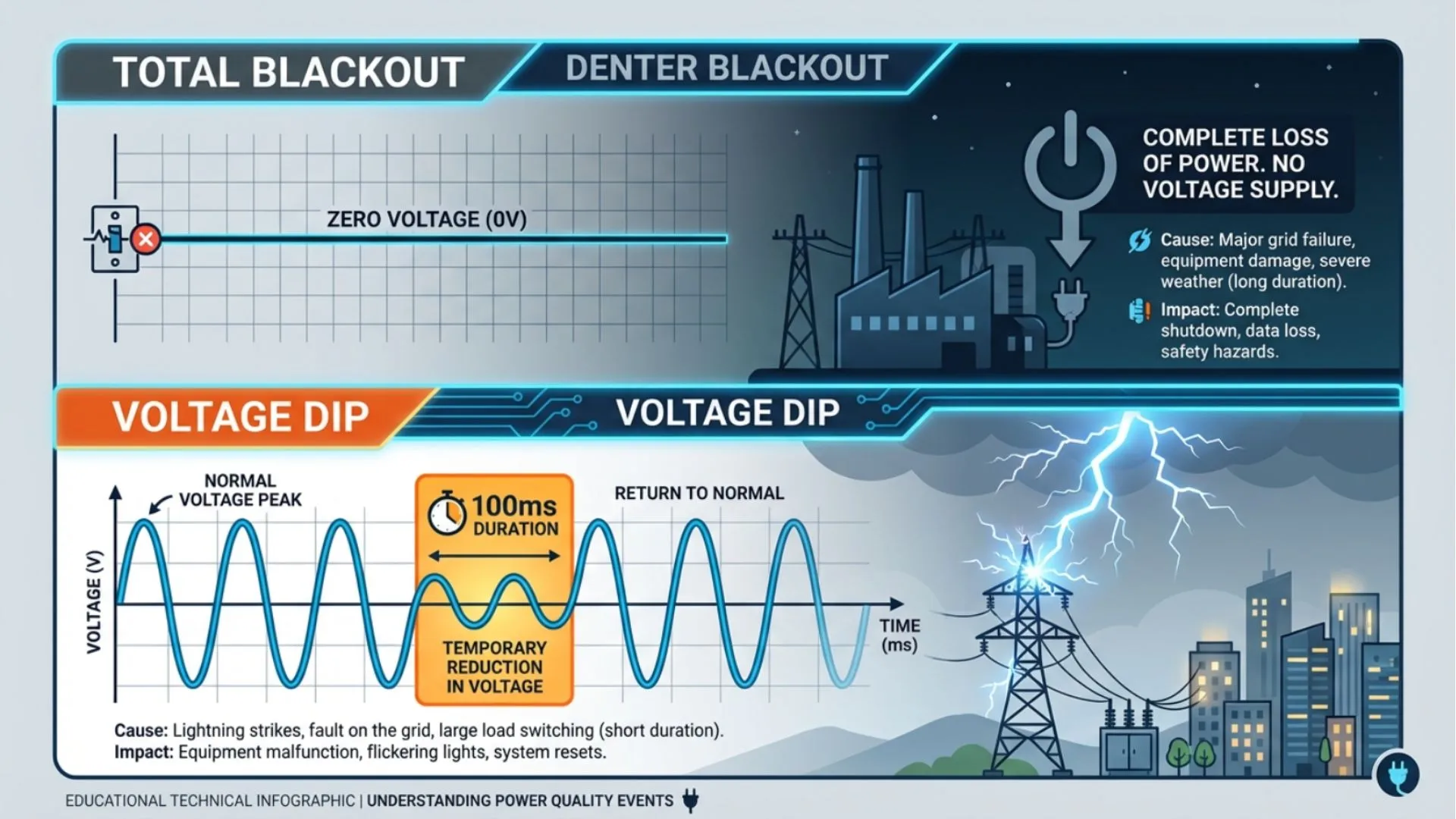
To understand this fundamentally, it is important to distinguish a voltage dip from a total blackout. During a complete power outage, the electricity supply drops entirely to zero and the connection to the grid is lost. Conversely, during a voltage dip, the power remains on. The lights might flicker, but the electrical feed continues to flow. This temporary drop in Root Mean Square (RMS) voltage means the equipment connected to that grid receives less electrical pressure than it requires to operate correctly.
Sensitive microprocessors, programmable logic controllers (PLCs), and variable frequency drives (VFDs) rely on a constant, stable sine wave of electrical power. The moment that voltage drops below a specific operational threshold, the equipment behaves erratically. Relays chatter, contactors drop out, and automated assembly lines grind to a sudden halt. Understanding this phenomenon is the foundational step in protecting high-value manufacturing assets from unprogrammed downtime.
How a Voltage Dip Behaves
To visualise a voltage dip, picture the standard alternating current (AC) power supply as a smooth, continuous wave rising and falling at a steady frequency — 50 Hz or 60 Hz depending on your region. When a sag occurs, the amplitude of this wave suddenly shrinks for a fraction of a second before returning to its original height.
Many voltage sags last no longer than 100 milliseconds — roughly five to six cycles. That may go entirely unnoticed by human eyes, but high-speed industrial sensors register the anomaly immediately and will often trigger a protective shutdown to protect internal circuits.
Tracking the frequency and depth of these compressed waveforms is how engineers begin diagnosing broader power interruptions within a facility. Without mapping the exact waveform behaviour, facility managers cannot determine whether a machine tripped due to an internal mechanical failure or an external power quality event.
What Causes Voltage Dips in Industrial Facilities?
Identifying the root cause of a voltage sag requires examining both the external utility grid and the internal electrical distribution network. Facilities share their power source with thousands of other users and kilometres of exposed transmission lines, making them vulnerable to events occurring far outside their perimeter.
Grid-Level Faults
Lightning strikes hitting transmission towers cause flashovers on utility lines. When such a fault occurs, the utility's protection systems react by opening and closing large circuit breakers to isolate the problem. During that brief clearing period — often just 50 to 100 milliseconds — the voltage across the entire connected network drops significantly.
Other grid-level causes include vehicle accidents involving power poles, construction crews severing underground cables, and wildlife interfering with substation transformers. Even a fault occurring fifty kilometres away forces the shared grid voltage to dip temporarily while the utility isolates the affected sector.
Heavy Machinery Start-Ups
Internal causes account for a large percentage of voltage sags in manufacturing plants. The most frequent culprit is the starting of large induction motors. When a heavy-duty motor starts, it requires an immense influx of power — known as inrush current — to overcome mechanical inertia and reach operating speed. This inrush current can be six to ten times higher than the motor's standard running current.
When a massive load such as an industrial chiller, large compressor, or heavy conveyor belt initiates, it draws so much current from the internal network that available voltage drops across the entire facility. Modern plants deploy a dedicated power monitoring system to track these internal spikes and allow engineers to stagger machine start times or deploy soft starters.
Short Circuits and Wiring Faults
Degraded insulation, loose terminal connections, and localised short circuits also pull voltage down. If a piece of equipment malfunctions and creates a short circuit, current rushes toward the point of failure, causing a corresponding voltage drop across adjacent circuits until the local circuit breaker clears the fault. Older facilities with ageing electrical infrastructure face a higher risk of these internal events.
The True Cost of Voltage Sags on the Factory Floor
A 50-millisecond voltage dip sounds insignificant. In practice, that fraction of a second destroys profit margins, compromises safety, and ruins hours of precise manufacturing work.
The semiconductor industry provides the starkest example. Silicon wafers undergo hundreds of complex deposition and etching processes inside vacuum chambers, guided by highly sensitive robotics. If a voltage sag hits the fab, the robotics lose positional data and vacuum pumps stall. The financial damage caused by voltage sags in semiconductor fabs runs into millions of dollars per incident — not just from scrapped wafers, but from the hours or days required to clean chambers, recalibrate equipment, and restart process verification.
In pharmaceutical manufacturing, a brief sag disrupts bioreactor temperature controls, forcing companies to discard entire batches due to regulatory compliance failures. In automotive assembly, a voltage drop causes robotic welding arms to mistime their operations, resulting in defective chassis that fail quality inspections.
Frequent voltage fluctuations also degrade the internal components of VFDs and power supplies over time. Capacitors overheat, insulation breaks down, and the lifespan of multi-million-dollar equipment shortens drastically. Facility managers must treat power quality improvement as a capital asset concern, not an afterthought.
Free Technical Resource
Download the Voltage Dip White Paper
Proven Methods to Protect Sensitive Equipment
Protecting a high-speed manufacturing environment requires technologies capable of detecting a voltage anomaly and injecting corrective power within milliseconds. When evaluating options, facility managers typically weigh DYSC vs traditional UPS for voltage sag protection.
A UPS relies on large banks of chemical batteries to provide backup power during a total blackout. While effective for continuous power, traditional UPS systems require extensive climate-controlled space, demand regular battery replacement, and carry significant maintenance overheads. Critically, they are engineered for blackouts — not for the brief dips that constitute the vast majority of industrial power quality events.
This operational reality makes the Dynamic Sag Corrector (DYSC) the superior choice for manufacturing. A DYSC operates without batteries, using static capacitors and advanced power electronics to store a reserve of energy. The moment incoming voltage drops below a safe threshold, the DYSC discharges its stored energy to reconstruct the missing portion of the sine wave — so quickly that protected equipment operates entirely unaware a grid fault occurred.
Integrating a DYSC voltage sag protector on PLCs, robotic controllers, and extrusion machines translates directly to measurable cost savings. The return on investment is frequently realised after preventing just one or two major sag events.
Why SEMI F47 Compliance Matters
You cannot protect equipment if you do not know its exact failure threshold. This necessity drove the creation of SEMI F47 — the global industry standard for voltage sag immunity.
Originally developed for the semiconductor sector, SEMI F47 has become the benchmark for high-tech industrial machinery worldwide. The standard dictates a specific voltage-time curve that equipment must survive without interruption: 50% of nominal voltage for 200 milliseconds, 70% for 500 milliseconds, and 80% for a full second.
During SEMI F47 testing, specialised engineers use advanced voltage sag generators to artificially create deep voltage dips and inject them directly into a machine's power supply, monitoring controllers, power supplies, and safety relays throughout.
OEMs and facility managers rely on trusted SEMI F47 testing services to certify tools before deployment. Achieving this certification provides engineering-level confidence that equipment will withstand the harsh electrical realities of an industrial power grid.
Build a Resilient Manufacturing Environment
Voltage dips are an unavoidable reality of modern electrical grids. As industrial machinery grows more reliant on sensitive microprocessors, the financial impact of poor power quality multiplies. Accepting unprogrammed downtime as a standard cost of doing business is no longer viable for competitive manufacturers.
Securing your facility requires a proactive approach: map your internal loads, understand the vulnerabilities of your specific equipment, and deploy targeted mitigation technologies such as Dynamic Sag Correctors to shield your most critical assets.
Frequently Asked Questions
Ready to Protect Your Production Line?
Download our Voltage Dip White Paper for in-depth engineering specifications and sag mitigation strategies tailored for industrial facilities.
Download the White Paper