


Voltage Dip Mitigation Strategies: Choosing the Right Compensator and Protection System
A voltage dip compensator is an industrial power quality device designed to detect and correct momentary drops in voltage within milliseconds. By maintaining a stable supply during sags, these systems prevent equipment tripping and costly production downtime in critical sectors like semiconductor manufacturing and automated assembly.
- Voltage sags are short-term drops in power that cause more industrial downtime than total blackouts.
- SEMI F47 is the global standard for "ride-through" capability in semiconductor and precision equipment.
- Dynamic Sag Correctors (DYSC) provide battery-free, high-efficiency protection with a service life of over 15 years.
- DYSC vs UPS: Choose DYSC for sags and transients to avoid the high maintenance costs and energy losses associated with traditional batteries.
What is a Voltage Dip (Sag) and Why Does It Threaten Modern Manufacturing?
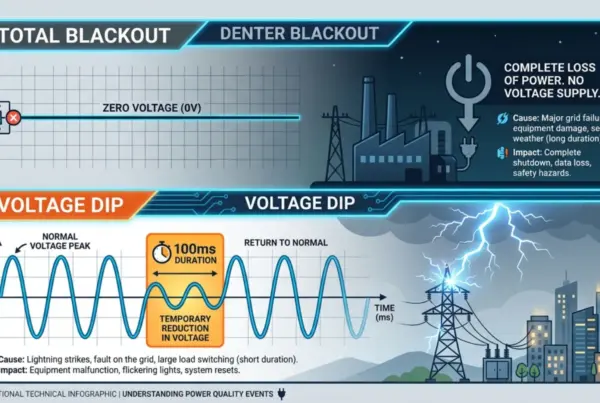
A voltage dip — or sag — is a short-duration reduction in RMS voltage, typically lasting between 0.5 cycles to one minute. Caused by weather, grid switching, or heavy motor starts, these micro-interruptions trip sensitive electronics, halting production lines, causing data loss, and inflicting significant hardware damage in automated environments.
While many operators worry about total blackouts, power interruptions in the form of voltage sags are far more frequent and often more damaging. In high-precision environments — such as voltage sags in semiconductor fabs — even a drop to 90% of nominal voltage for a few milliseconds can cause a latched fault. This triggers a chain reaction: robots lose their position, batches are scrapped, and hours are spent on recalibration.
To combat this, the industry relies on ride-through standards. The most prominent is SEMI F47, which defines the immunity requirements for semiconductor processing equipment, mandating that machinery must ride through specified dip depths and durations without failing. In South Korea, Samsung implemented the Samsung Power Vaccine programme — a rigorous set of internal standards and hardware implementations designed to render their production lines immune to grid disturbances.
The Hidden Costs of Power Quality Issues
The financial impact of voltage dips extends far beyond the immediate loss of power. It encompasses what engineers call the Iceberg Effect: wasted raw materials (scrap), labour hours for machine resets, missed delivery deadlines, and long-term degradation of sensitive electronic components that leads to premature equipment failure.
When evaluating how to minimise electrical facility problems and costs, the impact on Overall Equipment Effectiveness (OEE) cannot be ignored. A single 200ms sag can suppress your OEE score for an entire shift. For an SG-based SME, these hidden costs erode margins quickly, making cost savings with DYSC not just a technical preference, but a strategic financial decision.
| Cost Category | Impact of Voltage Dips | Long-term Consequence |
|---|---|---|
| Immediate | Scrapped WIP (Work in Progress) | Reduced profit margins |
| Operational | Labour costs for machine restarts | Missed KPIs and delivery delays |
| Technical | Stress on power supplies | Shortened equipment lifespan |
| Strategic | Reputation damage with clients | Loss of competitive edge |
How Does a Voltage Dip Compensator (DYSC) Work?
A Voltage Dip Compensator — specifically a Dynamic Sag Corrector (DYSC) — is a battery-free solution that uses patented technology to detect a voltage sag within 2 milliseconds. It immediately boosts voltage back to nominal levels by drawing energy from the remaining supply or internal super-capacitors, ensuring zero production interruption.
The DYSC's defining advantage lies in its speed and efficiency. Unlike traditional systems that wait for total failure, the DYSC activates the moment a deviation occurs. This is particularly critical for industrial automation solutions where PLCs and variable speed drives (VSDs) have very low tolerance for voltage fluctuations.
In a typical installation, the DYSC operates in standby mode with extremely low losses — often achieving greater than 99% efficiency. When it detects a dip matching the criteria defined by standards such as SEMI F47 or the Samsung Power Vaccine philosophy, it injects the necessary voltage to bridge the gap. This ride-through capability ensures that your manufacturing automation systems remain synchronised and fully operational.
Technical Note: Sub-Cycle Response
The DYSC responds in under 2 milliseconds — faster than the 8.33ms half-cycle threshold at which most PLCs and servo drives register a fault. This sub-cycle response is the defining characteristic that separates a DYSC from slower mitigation devices.
Free Resource
Download the Voltage Dip White Paper
DYSC vs. Traditional UPS: Choosing the Right Protection for Your Facility
While a Uninterruptible Power Supply (UPS) is engineered for long-term outages using batteries, a DYSC is optimised for the 98% of power events that are short-term sags. DYSCs are battery-free, require virtually no maintenance, occupy a smaller footprint, and deliver a significantly higher efficiency rating than double-conversion UPS units.
Selecting between the two depends on your primary threat profile. If your facility is in an area prone to total blackouts lasting minutes or hours, a UPS remains necessary. For most industrial zones in Singapore, the predominant threat is transient. The DYSC vs traditional UPS comparison typically resolves in favour of the DYSC for manufacturing environments, not least because of the environmental and energy efficiency benefits of eliminating battery-based infrastructure.
| Feature | Dynamic Sag Corrector (DYSC) | Traditional UPS (Battery) |
|---|---|---|
| Primary Function | Corrects sags/dips (< 5 seconds) | Provides backup for outages |
| Energy Storage | Capacitors (Battery-free) | Lead-acid or Lithium batteries |
| Maintenance | Minimal (15+ year service life) | High (battery replacement every 3–5 years) |
| Efficiency | >99% | 85% – 95% |
| Response Time | < 2 milliseconds | Often involves a transfer delay |
Ensuring Reliability: SEMI F47 Compliance and Industry 4.0 Integration
Reliability in 2026 requires more than hardware — it requires compliance with global standards such as SEMI F47 and seamless integration into the broader Industry 4.0 ecosystem. A modern voltage dip compensator should provide data for power monitoring systems, enabling predictive maintenance and long-term energy management.
SEMI F47 compliance demonstrates future-readiness — a requirement that fits directly into the 6 principles of a smart factory, where industrial energy management is automated and data-driven.
LKH Precicon's approach treats power quality as a core pillar of smart manufacturing. When your DYSC is connected to an EcoStruxure Power Monitoring Expert system, you are no longer simply reacting to sags — you are harvesting actionable data that illuminates the health of your entire electrical facility and informs capital planning decisions.
Taking the Next Step in Power Quality Management
Achieving ride-through excellence is not simply a matter of purchasing a device. It requires a power quality improvement strategy tailored to your specific load profiles and equipment sensitivity thresholds. Whether you are evaluating predictive maintenance for a sustainable manufacturing future or addressing a single machine-tripping issue, the quality of your engineering partner is decisive.
LKH Precicon brings over 40 years of expertise in Singapore's industrial sector, providing guidance across the full project lifecycle — from initial SEMI F47 testing services to the installation and commissioning of Allen-Bradley DYSC voltage sag protectors.
Frequently Asked Questions
Ready to Eliminate Costly Production Downtime?
Our technical experts have compiled a definitive guide on quantifying the ROI of voltage dip protection and selecting the right specifications for your facility.
Download the Voltage Dip White Paper