

Over one weekend in October 2026, attackers remotely forced refrigeration controllers in French supermarkets into defrost cycles. No production line was touched, yet the lesson for every manufacturer is direct: a connected machine that is old, exposed and unwatched can be turned against its owner.
- Attackers do not need to steal data to hurt a business. Changing what a physical machine does is enough.
- SME factories share the same exposure, and seven controls, applied in priority order, address most of it without an enterprise budget.
- Our white paper sets out those seven controls and a 12-month roadmap. Download it below.
Download the white paper
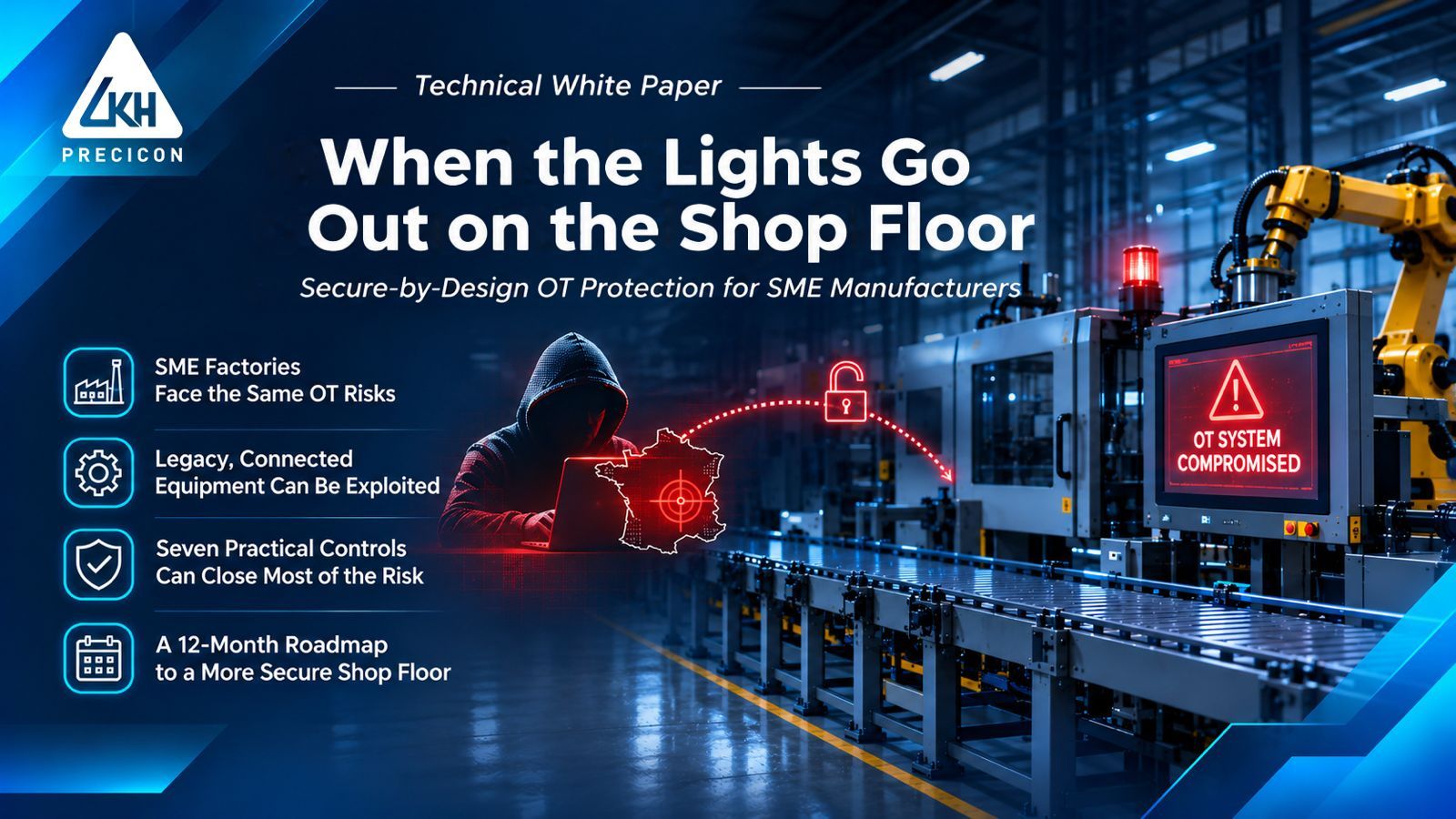
When the Lights Go Out on the Shop Floor: Secure-by-Design OT Protection for SME Manufacturers
What happened in France
On 12 October 2026, French retailers confirmed that a weekend cyberattack had hit refrigeration systems across their store networks. According to CBS News, hundreds of stores were targeted, stock was discarded, and the Paris prosecutor's office confirmed that the attack led to fires. The equipment maker said most affected units were older models that no longer receive security updates.
This was an attack on operational technology (OT), not on IT. The damage came from changing what a physical machine did. Replace "supermarket fridge" with "curing oven" or "packaging line" and the same story could unfold in a factory.
Why SME factories are exposed
Most SME factories were designed to run, not to be attacked. Flat networks, ageing controllers and permanent vendor connections now put many of them within reach of the internet, and for an SME the cost of an incident is lost production, missed deliveries and customer confidence.
Talk to an Engineer
Not sure what is connected to your production network?
Seven controls, in brief
You cannot protect everything equally on an SME budget, and you do not need to. The white paper argues for seven controls, in priority order:
- Separate the shop floor from the office
- Control remote access
- Know what is connected
- Back up what you need to restart
- Manage accounts and passwords
- Secure the data foundation
- Prepare people and plans
The paper explains how to apply each one on a real shop floor. In Singapore, the Cyber Security Agency's Cyber Essentials and Cyber Trust marks now cover operational technology, so it also helps you work towards a recognised mark.
Get the full white paper
Inside the paper you will find:
- the detail behind each of the seven controls
- a practical 12-month roadmap in five phases
- a simple business-case test your board can apply
It was written by Colin Koh, Principal Consultant at LKH Precicon, who has worked in industrial automation, IIoT and industrial cybersecurity across ASEAN for more than 35 years. Use the form near the top of this page to download it.
How LKH Precicon can help
We bring more than 40 years of industrial automation experience in Singapore and ASEAN, so we plan OT security around production as well as firewalls. See our Secure Solutions, secure networking, secure access and secure edge protection pages, or speak to our engineers.
Frequently Asked Questions
Because the exposure does not depend on your size. Connected controllers, shared networks and permanent vendor links make a factory reachable, and the French refrigeration case shows that attackers can disrupt operations without any customer data being involved.
IT security protects data and business systems. OT security protects the machines and processes that run production, where the priorities are safety, uptime and keeping equipment doing exactly what it should.
Seven priority controls, how a single integrated platform can deliver them, a 12-month roadmap and a business-case test. It is free to download using the form on this page.
Talk to us about securing your shop floor
Tell us about your facility and LKH Precicon's engineering team will get back to you.
Contact Us