


A UPS system is a backup power device that instantly switches connected equipment to battery power whenever mains supply fails or fluctuates, protecting servers, medical devices, and production lines from blackouts, brownouts, surges, and electrical noise. For a facility, it's best understood as a business continuity tool rather than a battery.
- A UPS instantly switches critical equipment to battery power when mains power fails or drops, preventing data loss and equipment damage.
- It protects against four distinct problems: blackouts, brownouts, surges, and electrical noise, not just full outages.
- Three main types exist: standby, line-interactive, and online double-conversion, each suited to different equipment.
- A UPS is not the same as a generator or a Dynamic Sag Corrector (DYSC). Each solves a different part of the power quality problem.
- Treat a UPS as one part of a wider power quality assessment, not a standalone fix.
What is a UPS, exactly?
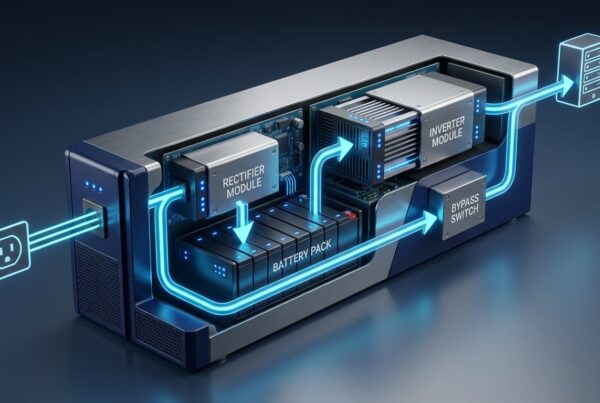
An uninterruptible power supply (UPS) is an electrical device that sits between the mains supply and your critical equipment, ready to take over the instant that supply drops, dips, or becomes unstable. Four components do the work: a rectifier converts incoming AC to DC, a battery stores that DC power, an inverter converts it back into usable AC, and a static bypass switch lets utility power flow straight through if the UPS itself needs servicing.
A generator can take anywhere from several seconds to a couple of minutes to start. A UPS responds in milliseconds, fast enough that a computer, a PLC, or a piece of laboratory equipment never registers the interruption at all. That near-instant handover buys enough time for equipment to shut down safely, or for a generator to spin up behind it.
The four power problems a UPS is built to solve
Most people picture a UPS as protection against one thing: the blackout, a total loss of power. That covers only a quarter of the job.
A brownout is a sustained drop in voltage without a full outage. The lights dim rather than go out, and the problem often passes unnoticed until equipment starts behaving oddly or failing outright. Because it lacks the drama of a blackout, a brownout is frequently the more damaging of the two. Sensitive electronics can be strained for hours before anyone realises what's happening.
Surges add a different risk: sudden spikes in voltage, often triggered by lightning strikes or heavy machinery switching on and off elsewhere on the grid. Electrical noise is quieter still, high-frequency interference that creeps into a power line and corrupts data or shortens component life without ever tripping a breaker.
A well-specified UPS addresses all four faults, not just the dramatic total outage. In industrial and commercial settings, these power problems occur more often than most facility teams expect, which is exactly why treating a UPS as "backup for blackouts" undersells the job it actually needs to do.
Why power quality matters more than the unit itself
Buying a UPS and calling the problem solved is a common mistake. The unit only protects what's plugged into it. If the incoming power is poor quality, undersized for the load, or subject to a fault the UPS wasn't specified to handle, everything upstream and downstream of it stays exposed.
According to Uptime Institute's 2024 outage research, 54% of organisations reported their most recent significant outage cost more than $100,000, and one in five put the figure above $1 million. For a continuous manufacturing line, a single voltage event during a production run can spoil an entire batch before anyone reaches the isolation switch.
It's also the source of a common false start: a team installs a larger UPS after a fault, only to have the same brownout trip production again a year later, because the sizing and the source of the fault were never diagnosed. Understanding where power quality problems actually originate turns a UPS from a reactive purchase into a deliberate part of how a facility manages risk. One protects a socket. The other protects the facility.
If your team has already had a near-miss with equipment damage or unplanned downtime, that's usually the point worth raising with a power quality specialist before buying anything.
Talk to an Engineer
Unsure whether a UPS is the right protection for your equipment?
The three main types of UPS systems
UPS systems fall into three broad categories, and the right one depends on how much protection your equipment actually needs.
| Type | How it works | Response | Best suited to |
|---|---|---|---|
| Standby (offline) | Runs equipment on mains power directly, switching to battery only when a fault is detected | A few milliseconds | Desktop computers, small office equipment |
| Line-interactive | Uses a built-in voltage regulator to correct minor sags and surges without switching to battery | Near-instant | Small server rooms, networking cabinets |
| Online (double-conversion) | Continuously converts incoming AC to DC and back to AC, so equipment always runs on conditioned power | Zero transfer time | Data centres, medical equipment, industrial control systems |
Online double-conversion units cost more to buy and run, since the inverter operates continuously rather than only during a fault. For equipment where even a few milliseconds of disruption is unacceptable, that cost is the price of genuine continuity rather than a lucky escape.
UPS vs. Dynamic Sag Correctors: what actually fits voltage sag issues?
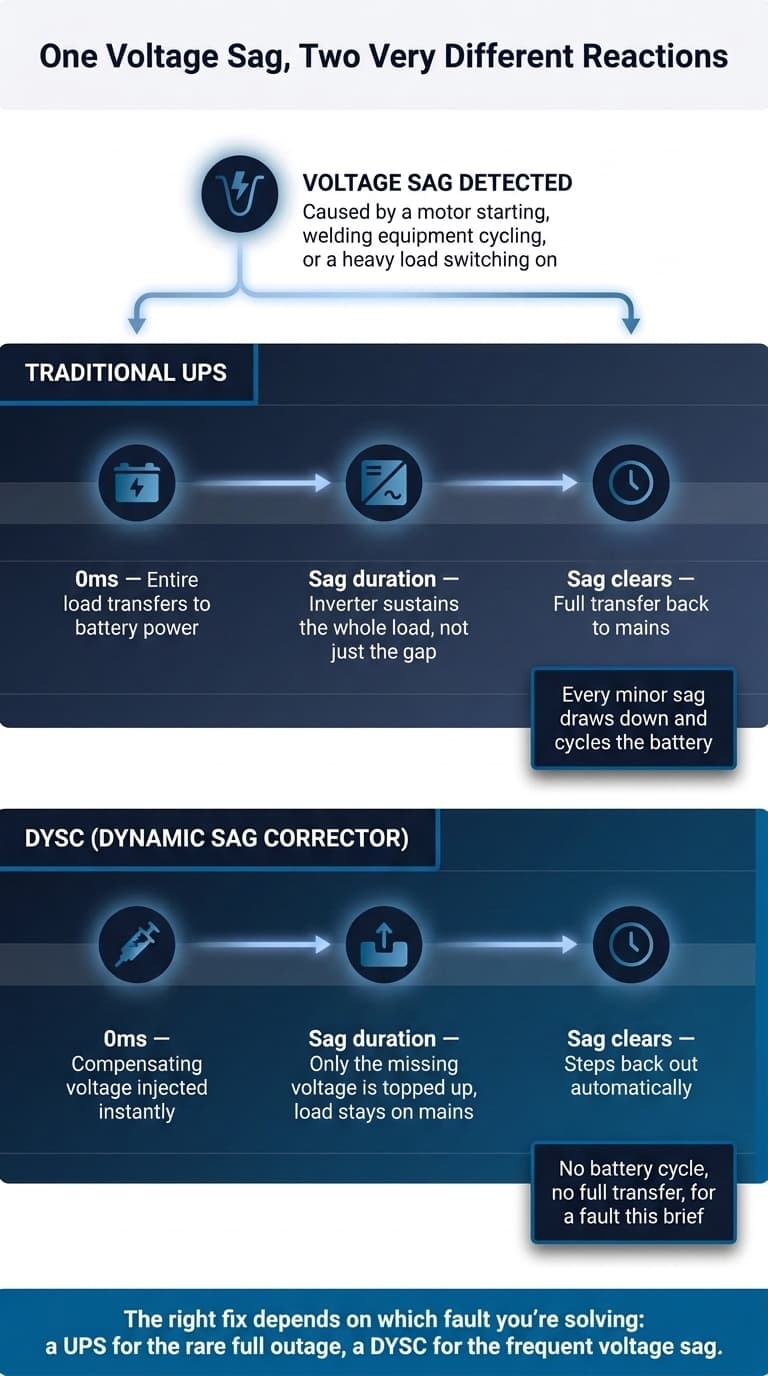
A traditional UPS is a general-purpose tool. It handles blackouts, brownouts, surges, and noise reasonably well across the board, but it isn't always the most efficient answer for one specific and very common industrial fault: the voltage sag caused by large motors starting, welding equipment cycling, or nearby heavy loads switching on.
A Dynamic Sag Corrector (DYSC) is built for exactly that fault. Rather than switching the whole load onto battery power for every dip, it injects a compensating voltage only for the split-second the sag lasts, then steps back out. For manufacturing lines where voltage sags are frequent but full outages are rare, that distinction matters: a detailed side-by-side comparison of DYSC and traditional UPS for voltage sag protection is worth reading before specifying either.
Some facilities need both: a UPS for the rare full outage, and a DYSC unit for the far more frequent sag events that a UPS would otherwise be asked to absorb every day.
Who needs a UPS, and what are the warning signs?
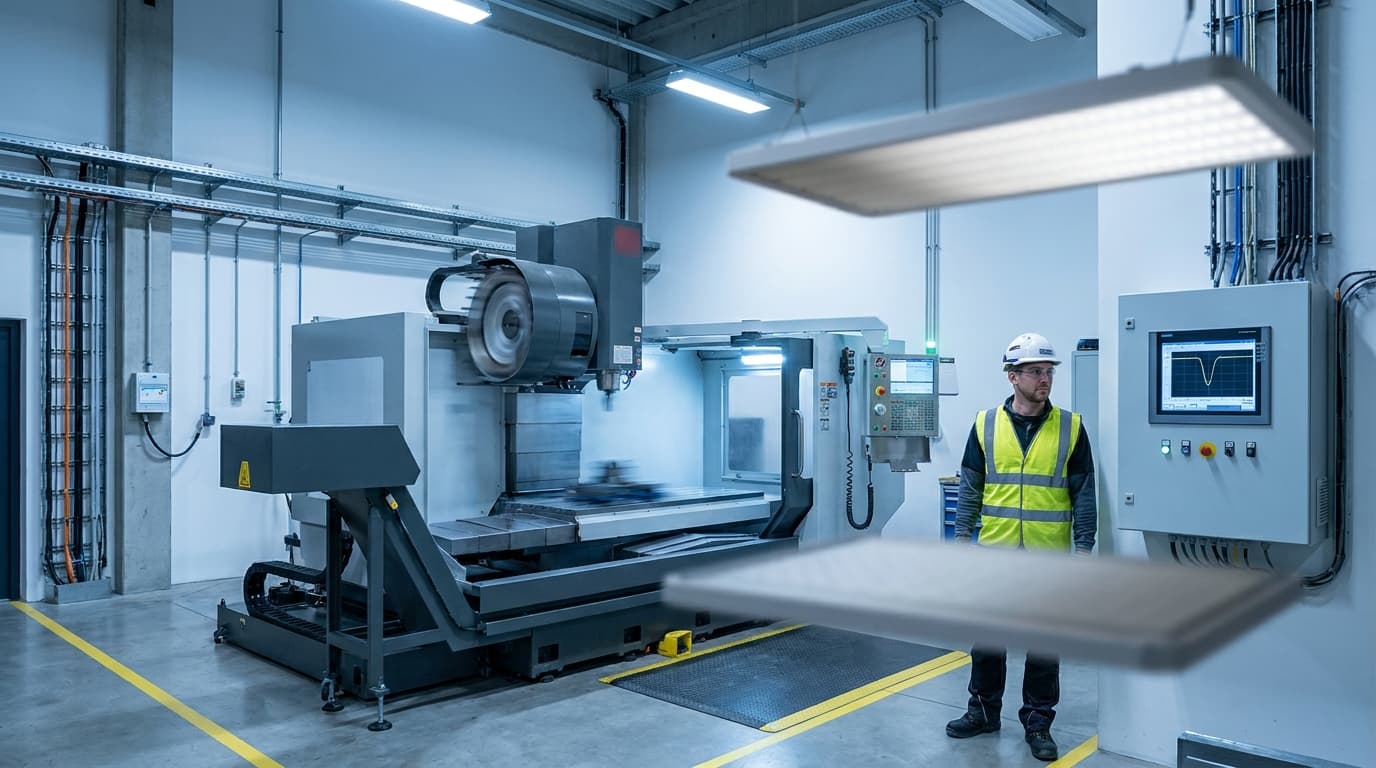
Data centres, hospitals, and financial institutions are the obvious candidates, but the need extends much further. Any facility running programmable logic controllers, SCADA systems, or automated production lines has equipment that can be damaged or knocked offline by a fault lasting less than a second.
Semiconductor fabrication is a particularly stark example: even a brief voltage sag can force an entire wafer batch to be scrapped, which is why voltage sag risk in semiconductor fabs gets specific attention as its own category rather than being folded into general power protection.
A few practical warning signs suggest it's time to look into UPS protection or a broader assessment:
Equipment resets or throws errors during storms or when large machinery starts up nearby
Lights dim noticeably when heavy loads switch on
You've had a near-miss with data loss or corrupted equipment firmware
Production downtime has occurred with no obvious cause traced back to the equipment itself
A closer look at how facilities have minimised these problems and their associated costs shows that the fix is rarely a single unit. It's usually a combination of protection, monitoring, and the right diagnosis of what's actually happening on the line.
Getting the right protection for your facility
A UPS system is a proven, well-understood piece of protection, but it's one part of a larger picture. The right specification depends on which of the four power problems your facility actually faces, how critical your equipment is, and whether a more targeted solution like a DYSC would serve certain loads better than a general-purpose UPS.
If you're weighing up UPS options, or unsure whether voltage sags, brownouts, or something else is behind recurring equipment issues, Precicon's energy management specialists can help you get a clear answer. Contact our team for enquiries about UPS systems and power quality solutions suited to your facility.
Frequently Asked Questions
No. A UPS draws backup power from batteries and activates instantly, while a generator relies on fuel and takes several seconds to start. A UPS typically runs for minutes, a generator for hours or days. In critical facilities, the two work together: the UPS bridges the gap the instant power fails, and the generator takes over once it's running.
Most UPS batteries last three to five years, depending on temperature, load, and how often they discharge fully. Lithium-ion batteries can last up to ten years, longer than the VRLA batteries found in most standard units. Frequent low-battery alarms or backup runtime dropping 30% or more below rated capacity are signs a battery needs replacing.
There are three: standby (offline), line-interactive, and online double-conversion. They differ in how much power conditioning they provide and how quickly they respond to a fault, with standby being the simplest and online double-conversion offering the highest level of protection.
A blackout is a complete loss of power. A brownout is a sustained drop in voltage without a full outage, and it's often more damaging because it goes unnoticed for longer while it strains equipment.
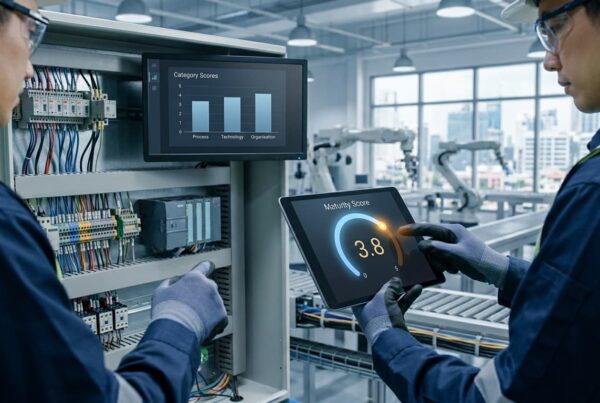
If your equipment includes PLCs, SCADA systems, servers, or any process where a sub-second interruption causes data loss or damaged output, a UPS is worth specifying. Recurring resets, dimming lights during heavy machinery start-up, or unexplained downtime are practical warning signs.
No. A UPS is a general-purpose backup power device, while a DYSC is built to correct voltage sags specifically, without switching the entire load onto battery power for every minor dip.
According to Uptime Institute's 2024 research, 54% of organisations reported their most recent significant outage cost over $100,000, with one in five reporting costs above $1 million. Manufacturing lines face an added risk of spoiled batches on top of that figure.
Get the right power protection for your facility
Tell us about your facility and LKH Precicon's engineering team will get back to you.
Contact Us