


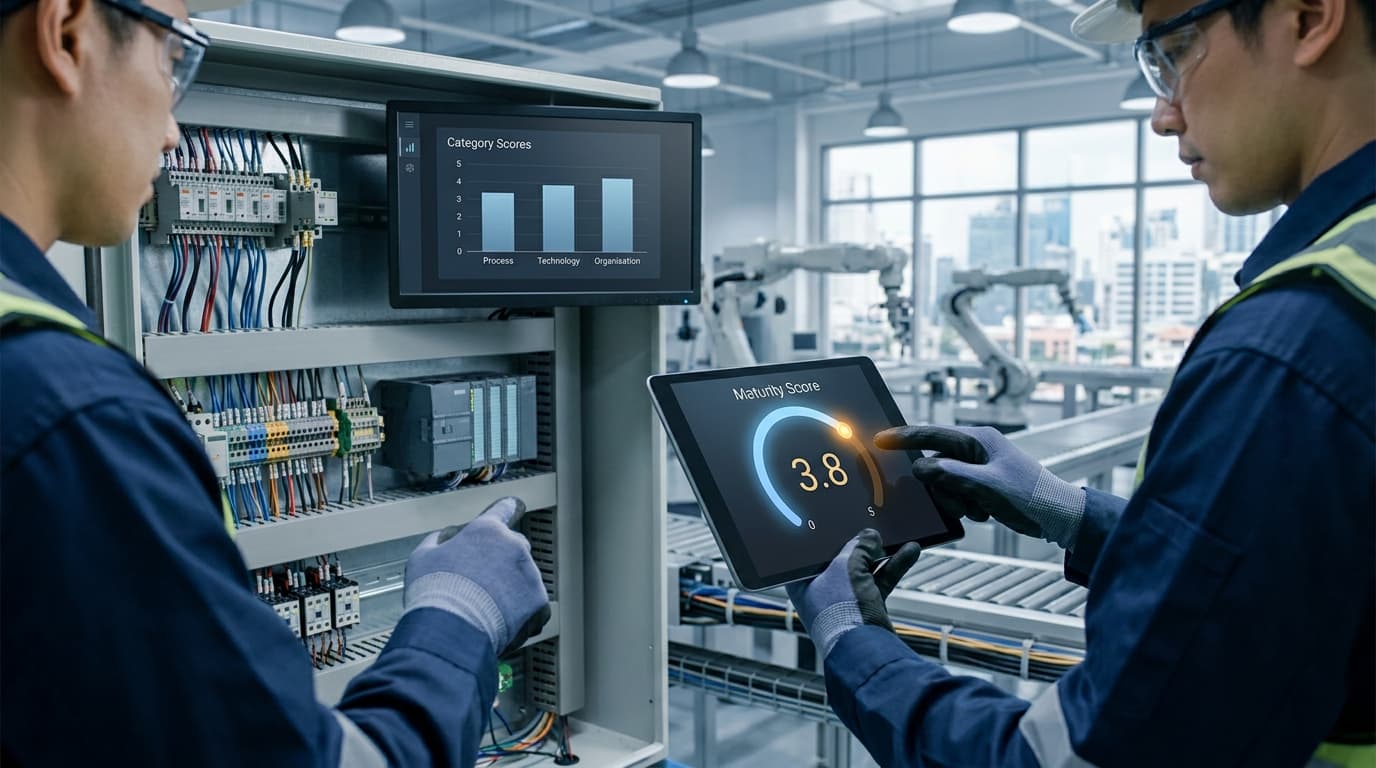
An Industry 4.0 maturity assessment measures how far a manufacturer has progressed in digital transformation across process, technology, and organisation. Frameworks such as Singapore's Smart Industry Readiness Index (SIRI), Germany's IMPULS, and the Warwick model each score readiness differently. The right choice depends on your company's size, industry, and objectives.
- An Industry 4.0 maturity assessment scores how far a factory has progressed in digital transformation, not just whether the technology exists.
- Readiness and maturity are different things: readiness is the starting-line infrastructure, maturity is how deeply it's embedded in daily operations.
- Every credible model, including SIRI, scores three pillars: process, technology, and organisation.
- SIRI, IMPULS, and Warwick suit different situations. For a Singapore manufacturer, SIRI is usually the practical starting point.
- A single-facility SIRI assessment typically starts from S$2,888 and takes a matter of weeks.
- You can run a rough self-assessment internally before calling a consultant. A checklist is included below.
Why industry 4.0 maturity matters for manufacturers
A production line can run for years without anyone measuring how smart it actually is. Machines get connected piecemeal, a dashboard appears here, a sensor gets bolted on there, and nobody steps back to ask whether the factory is genuinely more capable than it was five years ago. Teams often buy sensors before fixing process discipline, and end up with detailed data about a badly run process rather than a better-run one.
A maturity assessment answers the underlying question with a score, not a guess. According to Singapore's Economic Development Board, close to 600 manufacturing companies across 30 countries have used SIRI to benchmark their digital transformation. That scale matters: a Singapore-based manufacturer assessing its operations today is being measured against a genuinely international dataset, not a handful of local case studies. For plants operating in Singapore's manufacturing hub, that comparison carries real weight with investors, auditors, and regulators.
The assessment itself is not the end goal. It is the diagnostic step before any investment decision. Think of it as the equivalent of a health check before a training programme.
Maturity vs readiness: the difference that shapes your roadmap
Industry 4.0 readiness is a company's starting-line capability: whether the foundational conditions, such as connectivity, data infrastructure, and basic digital literacy, exist to begin a transformation at all. Industry 4.0 maturity is how far that transformation has actually progressed, scored across defined dimensions once those foundations are in place.
The distinction matters because most manufacturers use the terms interchangeably, and most published frameworks do too. A company can be "ready," with the infrastructure in place, without being "mature," because maturity accounts for how deeply that infrastructure is embedded into daily operations, decision-making, and workforce skills. Conflating the two leads to assessments that measure the wrong thing at the wrong stage.
The three building blocks behind every maturity model
Nearly every credible Industry 4.0 framework, SIRI included, scores a company against the same three pillars.
Process
Process covers how production is planned, executed, and improved, from shop-floor scheduling to how a factory responds when something goes wrong. A plant running on paper-based work orders scores low here regardless of how advanced its machines are.
Technology
Technology covers connectivity, automation, and intelligence: whether machines talk to each other, whether data is collected in real time, and whether that data feeds back into decisions. This is where most companies focus first, and where advanced shop-floor technologies tend to have the most visible impact.
Organisation
Organisation covers people and structure: whether staff have the skills to operate new systems, and whether management supports cross-department data sharing rather than siloed reporting. This pillar is consistently the weakest for manufacturers moving fast on technology and slowly on training.
Comparing SIRI, IMPULS and Warwick: which model fits your factory
Three frameworks dominate practical Industry 4.0 assessment work, and each was built for a different starting context.
| Framework | Origin | Core scope | Best fit | Output |
|---|---|---|---|---|
| SIRI | Singapore (EDB, developed with TÜV SÜD) | 16 dimensions across Process, Technology, Organisation | Companies of any size, especially those benchmarking against Southeast Asian peers | Maturity score (0 to 5 per dimension) plus a prioritisation roadmap |
| IMPULS | Germany (VDMA-backed) | Six dimensions: strategy, smart factory, smart operations, smart products, data-driven services, employees | Larger manufacturers with established engineering functions | Readiness score against six dimensions |
| Warwick | UK (Warwick Manufacturing Group) | Supply chain and operations strategy, with a strong emphasis on integration | Companies where supply chain complexity is the main constraint | Strategic recommendations rather than a numeric score |
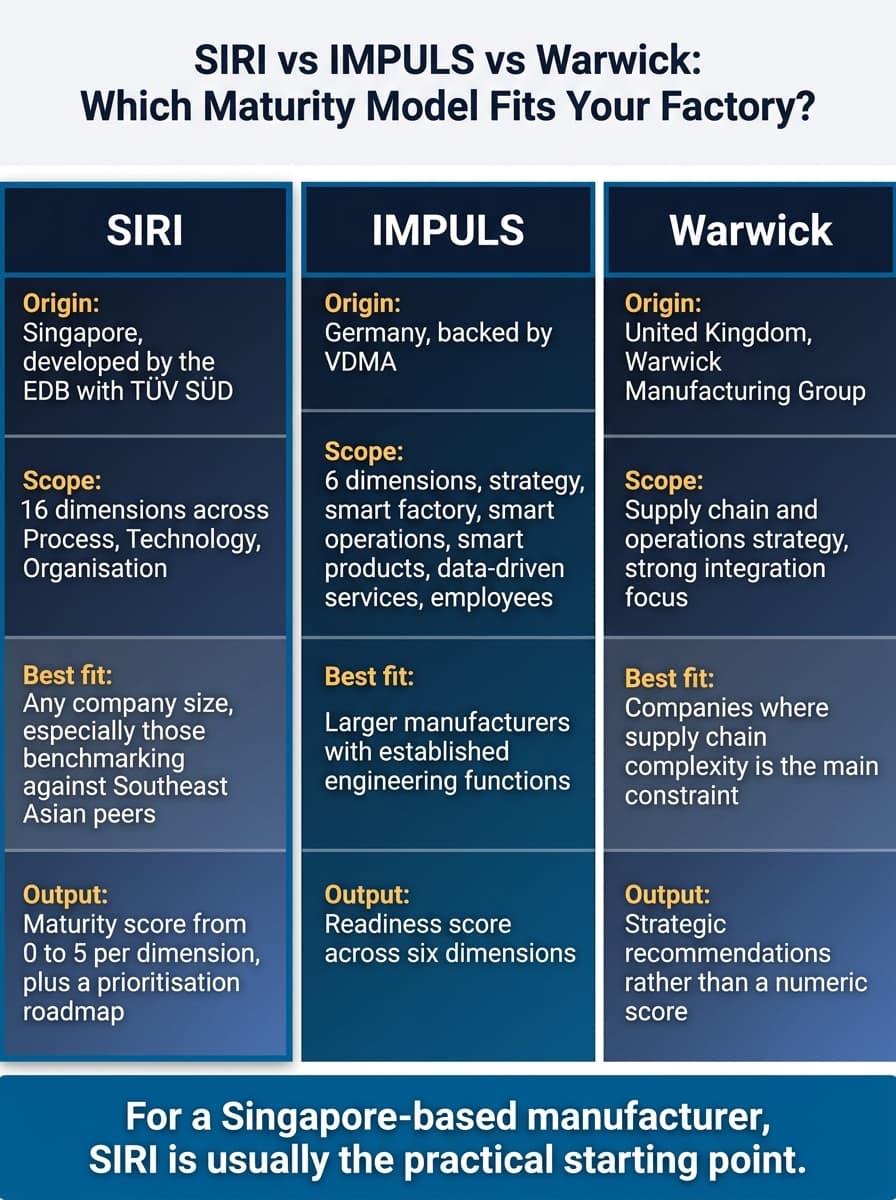
For a Singapore-based manufacturer, SIRI is usually the practical starting point. It is designed around the region's industrial base, and its certified assessor network makes external validation straightforward. IMPULS and Warwick remain useful reference points, particularly for a company that already operates German or UK facilities and needs a consistent scoring language across sites. If you would prefer an assessor to walk through which framework applies to your specific operation, our SIRI assessment service covers that scoping conversation before any formal audit begins.
Talk to an Engineer
Planning an Industry 4.0 maturity assessment?
What an industry 4.0 maturity assessment costs and how long it takes
Cost and timeline vary by scope, but a formal SIRI assessment for one facility typically starts from S$2,888, with larger or group engagements priced against the actual audit scope. That starting figure covers the structured diagnostic; it does not include implementing whatever gaps the assessment identifies.
Timeline follows the same logic. A diagnostic for a single facility, from initial consultation through to a debrief with findings, usually takes a matter of weeks rather than months. Most of that time goes into data collection and stakeholder interviews on the shop floor, not paperwork. An assessment spanning several facilities extends proportionally, since each site needs its own visit and data review.
Do SMEs actually need a maturity assessment
Smaller manufacturers often assume maturity assessments are built for large multinationals with dedicated transformation budgets. SIRI, like most credible frameworks, was explicitly designed to scale down. The diagnostic works the same way whether a facility has 20 staff or 2,000, though the recommendations that follow will look very different.
For an SME, the value of an assessment is arguably higher, not lower. Without a formal diagnostic, a smaller team is more likely to invest in the wrong technology first, simply because there is less internal capacity to evaluate options independently. A structured sustainability roadmap built for Singapore's industrial SMEs follows the same logic: sequence the investment correctly, and a smaller budget goes further.
A self-assessment checklist to run before you call a consultant
Before engaging a formal assessor, most manufacturing teams already have enough information internally to get a rough read on where they stand. Working through this checklist first also means a formal assessment, when it happens, moves faster.
Can you pull real-time production data from your main equipment, or does someone walk the floor with a clipboard?
Do you currently track Overall Equipment Effectiveness (OEE), and if so, how often is it reviewed against a target?
If a machine goes down, how long before the right person is notified, automatically or by someone noticing?
Can your systems trace a finished product back to the raw materials and process parameters used to make it?
Does your machine data collection feed into a central system, or does each machine sit in its own silo?
Has your team received formal training on any digital tools introduced in the last two years, or were systems handed over with minimal onboarding?
A team that struggles to answer more than two or three of these with confidence is likely at an early maturity stage, which is not a criticism, simply a starting point. The checklist will not replace a formal audit, but it narrows the conversation considerably once one begins.
How LKH Precicon supports your industry 4.0 transformation
LKH Precicon has run Industry 4.0 assessments and implementation projects across Singapore's manufacturing sector for over 40 years, working from the initial audit through to physical implementation and ongoing maintenance. Tai Sin Electric's digitisation programme is one example of that end-to-end approach in practice: a phased rollout rather than a single large deployment, which limited disruption to live production.
The same pattern holds for traceability work. One semiconductor client needed to trace finished products back to specific process parameters for compliance purposes, a requirement covered in more detail in our work on traceability in digital industry. Assessments that stop at a scorecard rarely change anything on the shop floor. The value comes from pairing the diagnostic with a team that has actually implemented the fixes it recommends.
Ready to find out where your factory actually stands
A scorecard on its own does not fix anything. The value is in what happens after it. If you would like to discuss an Industry 4.0 maturity assessment for your facility, get in touch with our team about a custom SIRI assessment, and we can scope what a diagnostic would look like for your operation.
Frequently Asked Questions
Readiness measures whether the basic infrastructure and conditions for digital transformation exist. Maturity measures how far that transformation has actually progressed once those foundations are in place.
Yes. SIRI and comparable frameworks are designed to scale to smaller facilities, and the diagnostic often has more value for SMEs, since a formal assessment reduces the risk of investing in the wrong technology first.
A single-facility SIRI assessment typically starts from S$2,888, with larger or group engagements priced against the full audit scope.
A diagnostic for one facility usually takes a matter of weeks from initial consultation to debrief. An assessment spanning several facilities takes longer, since each site requires its own data collection and review.
SIRI is generally the most practical starting point for Singapore-based manufacturers, since it was developed for the region and has a local certified assessor network. IMPULS or Warwick may be more relevant for a company with German or UK operations that needs a consistent scoring approach across sites.
Yes. A basic internal review, checking real-time data access, OEE tracking, traceability, and staff training, gives a rough read on maturity stage and makes a formal assessment more efficient when it happens.
Find out where your digital transformation stands
Tell us about your facility and LKH Precicon's engineering team will get back to you.
Contact Us