

The Smart Industry Readiness Index (SIRI) is an Industry 4.0 assessment framework developed by Singapore's Economic Development Board in 2017 and endorsed by the World Economic Forum. It helps manufacturers benchmark digital maturity across Process, Technology, and Organisation, using eight pillars and sixteen dimensions to build a prioritised transformation roadmap.
- SIRI is Singapore's Industry 4.0 assessment framework, built by the EDB and TUV SUD in 2017 and now managed by INCIT.
- It scores manufacturers across 3 building blocks, 8 pillars, and 16 dimensions.
- Each dimension is rated on a maturity band from Band 0 to Band 5.
- A typical assessment involves 3 to 4 weeks of preparation, 2 to 3 days on site, and a short debrief, according to INCIT.
- Pricing in Singapore commonly starts from around S$2,888 for a single site assessment, with SME grant support sometimes available.
- SIRI differs from acatech and IMPULS by relying on independent, on site verification rather than self reporting.
The origins of SIRI: Singapore's contribution to global manufacturing
Singapore launched SIRI in November 2017, jointly developed by the Economic Development Board (EDB) and TUV SUD. It gave manufacturers, regardless of size or sector, a shared way to describe where they actually stood on the path to Industry 4.0, rather than relying on internal opinion.
According to the World Economic Forum's 2022 report on the Global Smart Industry Readiness Index Initiative, SIRI has since been adopted well beyond Singapore, forming the basis for national and sectoral digital transformation strategies elsewhere. EDB's original whitepaper frames the index around a fairly blunt question: what separates a factory that has installed a few IoT sensors from one that has genuinely transformed?
That question matters because most "digital transformation" claims are hard to check from the outside. SIRI answers it with a structured, evidence based audit rather than a self reported checklist.
Breaking down the Smart Industry Readiness Index: 3 building blocks, 8 pillars, 16 dimensions
SIRI's structure runs in three layers. At the top sit three building blocks: Process, Technology, and Organisation, the same three levers most manufacturers pull when attempting a digital shift.
Underneath those sit eight pillars:
Operations
Supply Chain
Product Lifecycle
Automation
Connectivity
Intelligence
Talent Readiness
Structure and Management
Each pillar breaks down further into sixteen dimensions, the actual points an assessor scores, covering everything from shop floor connectivity to how decisions get made on the factory floor.
Process, Technology, Organisation: the 3 building blocks
Process covers how a factory plans, runs, and improves its operations, the same ground overall equipment effectiveness tracking already sits in. Technology covers the hardware and software stack: sensors, machine connectivity, and the smart manufacturing technologies now common on modern shop floors. Organisation is the one factories underestimate most. It covers whether staff have the skills and structure to actually use what the first two blocks provide.
A factory can score well on Technology and still fail on Organisation. That gap is usually where a transformation project quietly stalls, long after the equipment has already been paid for.
Who runs SIRI today? INCIT and the Global SIRI Initiative
The International Centre for Industrial Transformation (INCIT) is the non profit that has managed SIRI since 2021, after the World Economic Forum's Global SIRI Initiative moved administration out of EDB's hands. INCIT trains and certifies assessors, maintains the scoring methodology, and coordinates a growing list of countries now running their own SIRI programmes. It also confirms that assessments cover facilities of any size, benchmarked across 12 industry clusters and 59 industry segments.
This matters when comparing quotes. Not every consultant offering a "SIRI assessment" is using INCIT's certified methodology. Ask directly whether the assessor holds current INCIT endorsement before signing anything.
Understanding SIRI maturity bands: where does your factory stand?
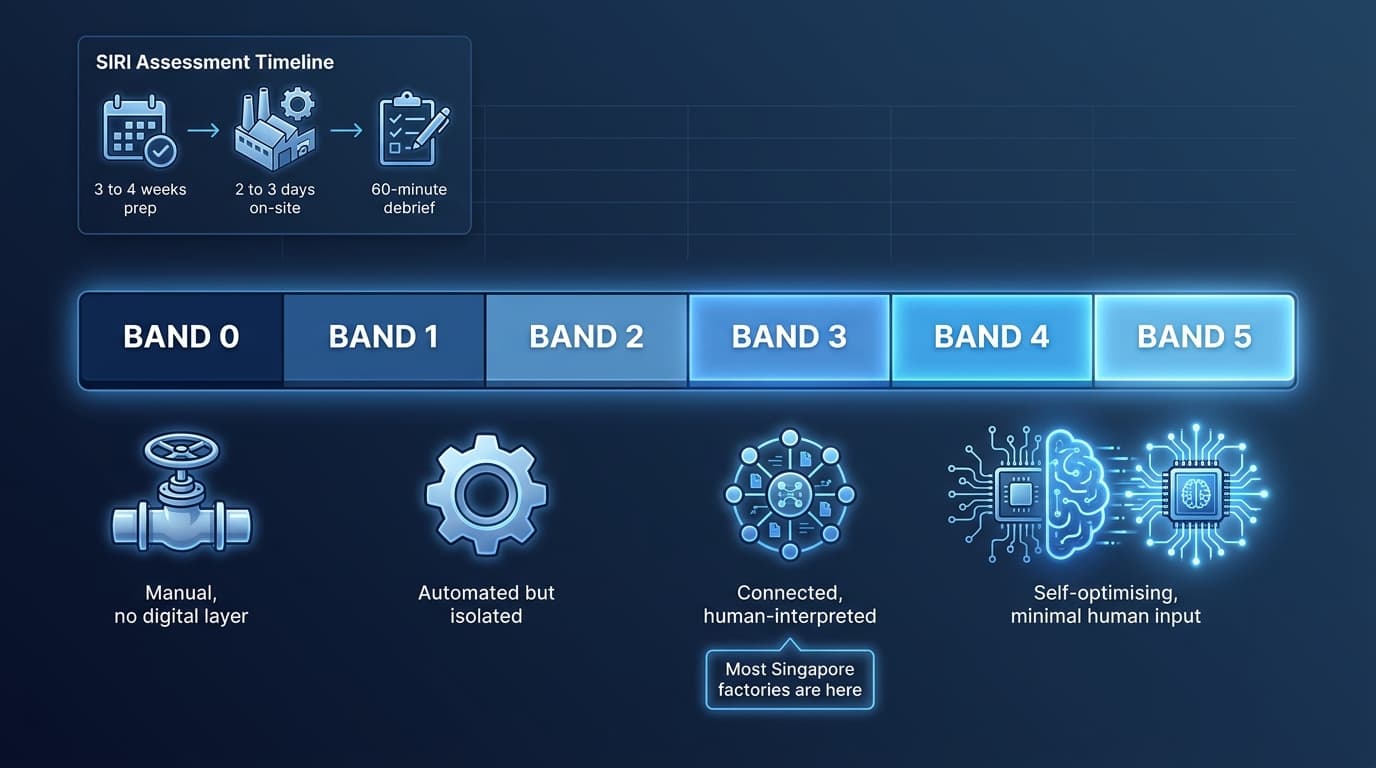
SIRI scores each dimension on a scale from Band 0 to Band 5:
Band 0: manual process, no digital layer in place
Bands 1 and 2: individual stations automated but not yet connected
Band 3: connected systems that can be monitored remotely but still depend heavily on human interpretation, where most assessed Singapore manufacturers land
Bands 4 and 5: systems that can predict problems and adjust themselves with limited human input
Knowing your band matters less than knowing why you're there. A SIRI Assessment produces a dimension by dimension score rather than one overall number, so a factory can see exactly which of the sixteen dimensions is holding the rest back.
Talk to an Engineer
Wondering where your factory stands on SIRI?
How long does a SIRI assessment take, and what does it cost in Singapore?
According to INCIT, the body that runs the programme, a SIRI assessment breaks into three phases:
Planning and preparation: roughly 3 to 4 weeks beforehand, requiring about 3 hours of internal commitment
On site assessment: 2 to 3 days on the factory floor, covering process inspection, systems review, and workforce skills evaluation
Debriefing and roadmap: a session of around 60 minutes after the assessment, where results are handed over as a prioritised, sequenced action plan
Pricing varies by assessor and factory size. Assessments in Singapore commonly start from around S$2,888 for a single site evaluation with LKH Precicon, though industry wide costs can run into the thousands per site depending on scope. Larger, multi site engagements cost more, scaled to the number of production lines and departments being scored.
Funding support exists for eligible Singapore SMEs. Government backed schemes, covered in more detail in our guide to government sustainability grants, can offset part of the assessment cost. Eligibility depends on company size and the specific grant in force at the time of application, so it's worth checking current terms before budgeting around it.
SIRI vs other Industry 4.0 maturity models: acatech and IMPULS
SIRI isn't the only maturity model in circulation. Germany's acatech Industrie 4.0 Maturity Index and the IMPULS Industry 4.0 Readiness Model are the two most commonly cited internationally.
| Framework | Origin | Structure | Best suited for |
|---|---|---|---|
| SIRI | Singapore (EDB/INCIT), 2017 | 3 building blocks, 8 pillars, 16 dimensions | Manufacturers wanting a globally benchmarked, third party verified score |
| acatech Industrie 4.0 Maturity Index | Germany, 2017 | 6 maturity stages across 4 structural areas | Companies wanting a stage based model tied closely to organisational capability |
| IMPULS Readiness Model | Germany (VDMA), 2015 | 6 dimensions, 18 items | Self assessment for mechanical engineering firms, less suited to third party certification |
The practical difference is verification. SIRI is the only one of the three built around independent, on site assessment rather than self reporting, which is a large part of why it has become the reference point in the WEF's own Global SIRI Initiative work.
Choosing a SIRI ready partner in Singapore
Singapore has no shortage of firms offering SIRI related services, from global certification bodies to boutique digital consultancies. Not all of them carry the same weight.
LKH Precicon has worked directly with Singapore's manufacturing and infrastructure sector since 1985, which gives it a different starting point from consultancies that arrived with the Industry 4.0 wave. Its SIRI Assessment service sits inside a broader 3S approach: Smart, Sustainable, Secure, built on the idea that a maturity score only matters if it leads somewhere. That thinking also runs through its factory digitalisation projects and its role in Singapore's manufacturing sector more broadly.
One question is worth asking before you commit: does the firm running your assessment only score you, or can it also implement what the scorecard recommends? A SIRI report that ends in a PDF and an invoice, with no one available to act on the findings, solves half the problem at best.
Where to go from here
A Smart Industry Readiness Index score is a starting point, not a verdict. Get in touch with LKH Precicon's team to talk through what a SIRI readiness pre-assessment would look like for your factory, or browse our wider work on smart factory solutions in Singapore before deciding where to start.
Frequently Asked Questions
SIRI is an Industry 4.0 assessment framework built by Singapore's Economic Development Board and TUV SUD in 2017, now managed by INCIT, used to benchmark a manufacturer's digital maturity across Process, Technology, and Organisation.
INCIT structures it in three phases: 3 to 4 weeks of preparation, 2 to 3 days on site, and a debrief of around 60 minutes before the final roadmap is issued.
Costs with LKH Precicon commonly start from around S$2,888 for a single site assessment, rising with the number of production lines, departments, and sites being evaluated.
The International Centre for Industrial Transformation (INCIT) has managed the SIRI methodology and certified its assessors since 2021, after taking over from Singapore's Economic Development Board.
SIRI scores each of its sixteen dimensions from Band 0 (manual, no digital layer) to Band 5 (self optimising systems with minimal human input), giving factories a dimension by dimension view rather than a single overall score.
Manufacturing facilities of any size are eligible. INCIT benchmarks results across 12 industry clusters and 59 industry segments so smaller and larger factories are compared fairly.
Manufacturers receive a set of deliverables that typically include maturity scores, benchmark comparisons, a transformation roadmap, a workforce capability analysis, and a short list of priority dimensions to act on first.
Some Singapore SMEs can offset assessment costs through government grant schemes, though eligibility depends on company size and the specific scheme available at the time of application.
SIRI relies on independent, on site verification rather than self reporting. That distinction is the main reason it has become the internationally referenced benchmark, including in the World Economic Forum's own Global SIRI Initiative.
Ready to benchmark your Industry 4.0 readiness?
Tell us about your facility and LKH Precicon's engineering team will get back to you.
Contact Us