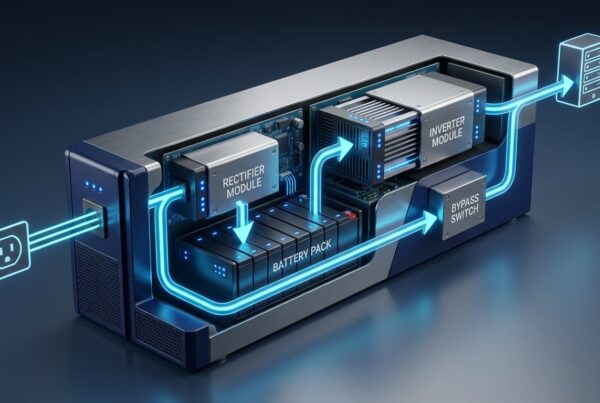


An electrical management system is a combination of hardware and software that monitors, controls, and optimises a facility's electrical infrastructure: power quality, load distribution, and equipment health, tracked in real time. Unlike a general energy management system, it focuses specifically on the electrical network itself, not a site's total energy mix.
- An electrical management system monitors and optimises a facility's electrical network specifically, not a site's total energy use.
- It differs from an energy management system, a BMS, and SCADA, each of which covers a broader or different scope.
- Core functions: real time monitoring, power quality management, fault and alarm detection, load management, and predictive maintenance.
- Singapore's peak electricity demand is forecast to grow up to 5% a year over the next five years (EMA, 2024), making electrical visibility increasingly important for industrial sites.
- LKH Precicon designs, installs, and supports electrical management systems for facilities in Singapore.
What is an electrical management system?
An electrical management system is a platform, built from hardware and software, that gives facility teams real time visibility into how electricity moves through a site. Sensors and smart meters sit at key points in the distribution network: switchgear, transformers, distribution panels, and individual machine circuits. The software layer collects that data continuously and turns it into something an engineer or plant manager can act on. You will also see this called an Electrical Power Management System (EPMS) in vendor literature and engineering standards; the terms are used interchangeably.
This differs from a broad energy strategy. An electrical management system is narrower by design. It exists to keep the electrical network stable, safe, and efficient, catching a failing circuit breaker before it fails, flagging a voltage sag before it trips a production line, and giving maintenance teams the data to fix problems before they become downtime.
Electrical management system vs. energy management system vs. BMS vs. SCADA
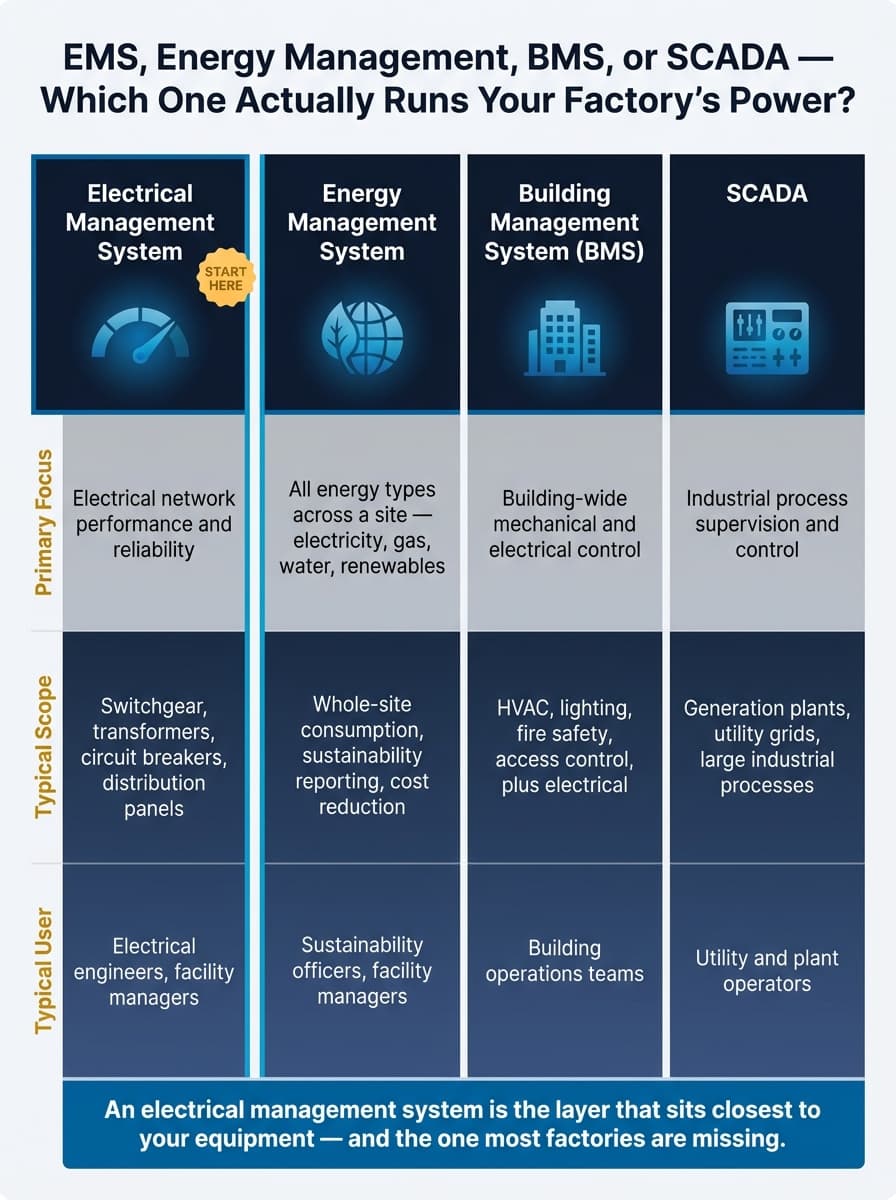
These four terms get used interchangeably in vendor brochures, which causes real confusion for anyone trying to scope a project. They are not the same thing.
| System | Primary focus | Typical scope | Typical user |
|---|---|---|---|
| Electrical Management System | Electrical network performance and reliability | Switchgear, transformers, circuit breakers, distribution panels | Electrical engineers, facility managers |
| Energy Management System | All energy types across a site (electricity, gas, water, renewables) | Whole site consumption, sustainability reporting, cost reduction | Sustainability officers, facility managers |
| Building Management System (BMS) | Building wide mechanical and electrical control | HVAC, lighting, fire safety, access control, plus electrical | Building operations teams |
| SCADA | Industrial process supervision and control | Generation plants, utility grids, large industrial processes | Utility and plant operators |
An electrical management system often sits underneath a broader energy management system, feeding it data on electrical performance specifically. It can also be layered with SCADA in utility or heavy industrial contexts, though SCADA's scope extends well beyond electrical assets into full process control. A BMS, by contrast, treats electrical monitoring as one function among many, alongside HVAC and lighting, which is why a facility with serious power quality concerns often outgrows what a standard BMS can offer and needs a dedicated electrical layer, as we cover in more detail here.
Key functions of an electrical management system
Strip away the marketing language and an electrical management system does five things well.
Real time monitoring
The system tracks voltage, current, frequency, and power factor continuously, not on a monthly billing cycle. This is the function that makes everything else possible: you cannot manage what you cannot see, and most facilities that operate without one discover problems only after equipment has already failed. Precicon's power monitoring systems are typically the first layer installed for exactly this reason.
Power quality management
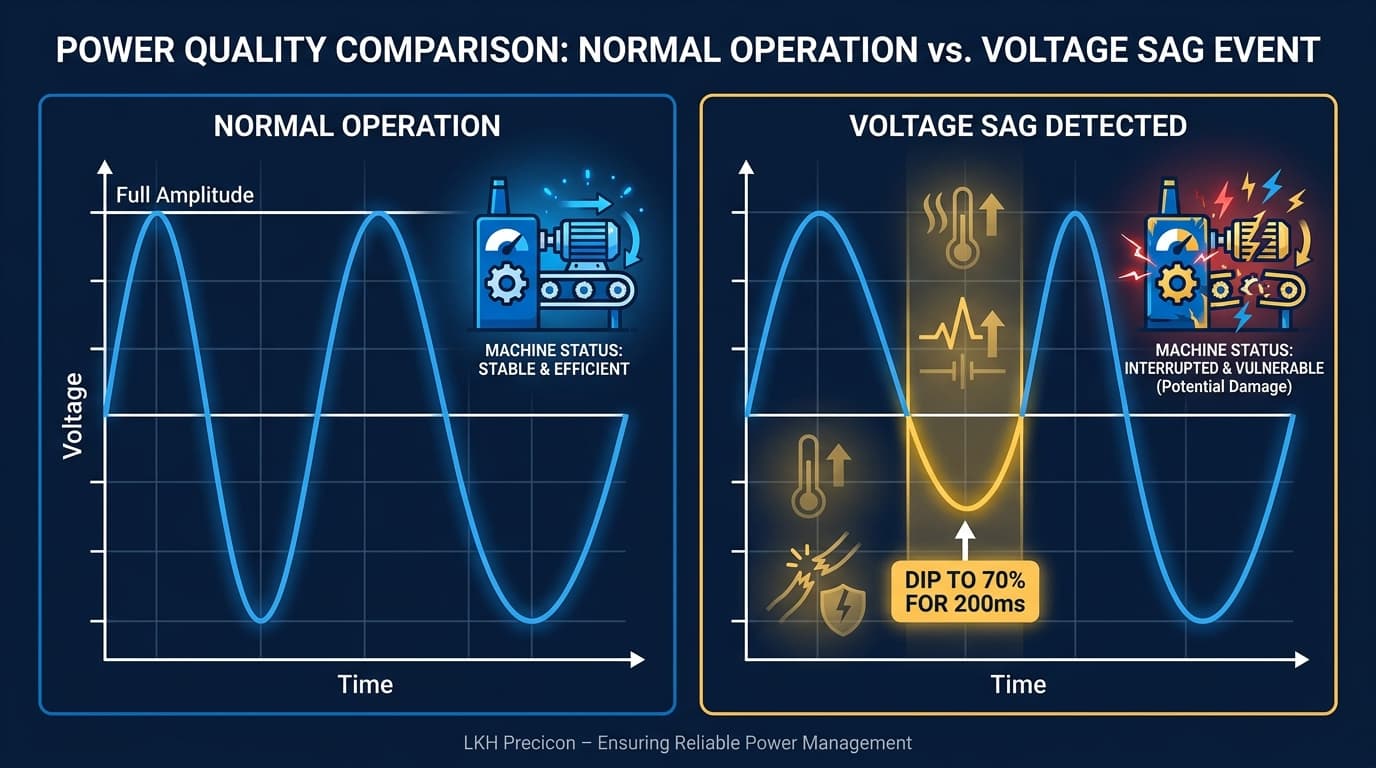
Voltage sags, harmonics, and phase imbalance degrade equipment over time and cause nuisance trips that are hard to trace back to a root cause. An electrical management system flags these events as they happen, with a timestamp and location, rather than leaving an engineer to guess which machine tripped first. Power quality improvement is often the single biggest driver behind an EMS purchase decision, ahead of cost savings.
Fault and alarm detection
Circuit breakers, transformers, and switchgear all generate early warning signs before they fail outright: rising temperatures, abnormal current draw, insulation degradation. The system correlates these signals and raises an alarm before the failure takes down a production line.
Load and demand management
By tracking which circuits draw the most power and when, the system lets facility teams shift non critical loads away from peak demand windows. This matters more in Singapore than in most markets, given how demand charges are structured for larger industrial accounts.
Equipment lifecycle and predictive maintenance
Historical data reveals which assets are degrading faster than expected, letting maintenance teams replace a component on their own schedule instead of the equipment's.
Not every facility gets the deployment right on the first attempt. Retrofitting sensors and metering into an operating plant without proper phasing can itself cause the downtime the system was meant to prevent, which is why sequencing matters as much as the technology.
Talk to an Engineer
Want better visibility of your electrical infrastructure?
Why electrical management matters for businesses in Singapore
According to Singapore's Energy Market Authority (2024), system peak electricity demand is forecast to grow at a compound annual rate of up to 5% over the next five years, driven by advanced manufacturing and the digital economy. For a facility already running close to its distribution capacity, that growth curve turns electrical management from a nice to have into an operational necessity.
There's a compliance angle too. Manufacturers working toward BCA Green Mark certification or applying for government sustainability grants need the kind of granular electrical data an EMS provides; utility bills alone will not satisfy an audit. The 5-step sustainability roadmap for Singapore's industrial SMEs treats electrical visibility as step one for exactly this reason. You cannot reduce what you have not measured.
Cost avoidance is the other side of it. A single voltage sag event can damage sensitive equipment or force a line restart that costs more than a year of monitoring software. Facilities that have already been through one unplanned outage tend not to need convincing twice.
How LKH Precicon helps you build a reliable electrical management system
A proven, end to end approach
LKH Precicon has worked on electrical and automation projects in Singapore since 1985. Our energy management system solutions cover the full path from initial audit through to design, installation, and ongoing support, rather than handing over hardware and leaving the integration work to the client's own team.
Real world results
In one engagement, a client reduced recurring electrical facility problems and their associated costs by moving from reactive fault finding to continuous monitoring. That pattern shows up across the sustainability success stories documented with Singapore based manufacturers: the return usually comes from fewer surprises, not from one dramatic saving.
Get expert advice on your electrical management system
An electrical management system pays for itself the first time it catches a fault before it becomes a shutdown. If you are weighing up whether your facility needs one, speak with LKH Precicon's energy management team about what a system tailored to your site would look like.
Frequently Asked Questions
An electrical management system focuses on monitoring and optimising electrical infrastructure specifically, while SCADA (Supervisory Control and Data Acquisition) is a broader industrial control framework that can span entire generation plants or process lines, of which electrical monitoring is only one part.
ISO 50001 is the international standard for energy management systems. It sets out a framework organisations can follow to establish, implement, and improve systematic energy performance, including the kind of electrical data an EMS collects.
An EMS (electrical or energy management system) focuses on power performance and consumption, while a BMS (Building Management System) controls the wider set of building services, including HVAC, lighting, and fire safety, with electrical monitoring as just one function among several.
Its core function is to monitor, analyse, and optimise electricity use and equipment performance within a facility, covering real time monitoring, power quality management, fault detection, load management, and predictive maintenance.
An electrical management system is narrower, focused specifically on the performance and reliability of electrical assets. An energy management system takes a broader view, covering all energy types across a site, including gas, water, and renewables, usually for sustainability and cost reduction purposes.
If your facility depends on continuous electrical supply for production, carries sensitive equipment vulnerable to power quality issues, or is working toward sustainability certification, an electrical management system is generally worth the investment. A short audit is usually enough to confirm the case.
Talk to us about electrical management for your site
Tell us about your facility and LKH Precicon's engineering team will get back to you.
Contact Us