

An energy management system (EMS) is software and hardware that monitors, controls, and optimises how a facility uses energy. It is distinct from a national grid control EMS. For an industrial or commercial site, an EMS tracks consumption, flags waste, and automates equipment to cut costs and, in some markets, meet regulatory obligations.
- An EMS combines meters, sensors, software, and control logic to monitor, analyse, and optimise a facility's energy use.
- Singapore has two distinct meanings of "EMS": the national grid control system run by the Energy Market Authority, and the facility level system this guide covers.
- Under Singapore's Energy Conservation Act, energy intensive companies must appoint a qualified energy manager and implement an EMS aligned with ISO 50001.
- Eligible organisations can access co funding of up to 70% for EnMS or ISO 50001 projects through schemes linked to Enterprise Singapore.
- Cost scales with scope. Facilities that act on the data quickly recover their investment faster than those that only check dashboards occasionally.
- A free energy audit or SIRI Assessment is the fastest way to establish a real baseline before committing capital.
What is an energy management system, really?
Ask ten people what "EMS" means and you will likely get ten different answers. That is not a knowledge gap. It is a terminology problem.
At its core, an energy management system combines sensors, software, and control logic to give a facility visibility over its own energy use, then act on that visibility. It measures electricity, gas, water, or steam consumption at the meter or sub-meter level. It feeds that data into software that spots patterns and waste. Where it is integrated with building or industrial control systems, it automatically adjusts equipment such as HVAC, lighting, or compressors in response.
There is a wrinkle specific to Singapore worth clearing up early. Search for "energy management system" locally and you will also find the Energy Market Authority's own EMS: a mission critical system that monitors the island's power grid and generating plants. That is a different system entirely, run at national level rather than installed in a single building. This article is about the facility level version, the one relevant to a plant manager, building owner, or industrial energy manager trying to cut costs and meet compliance targets.
For a broader look at how these technologies fit into a wider efficiency strategy, industrial energy management covers the analytics and smart metering layer in more detail.
How does an energy management system work?
Strip away the branding and an EMS does four things, in order.
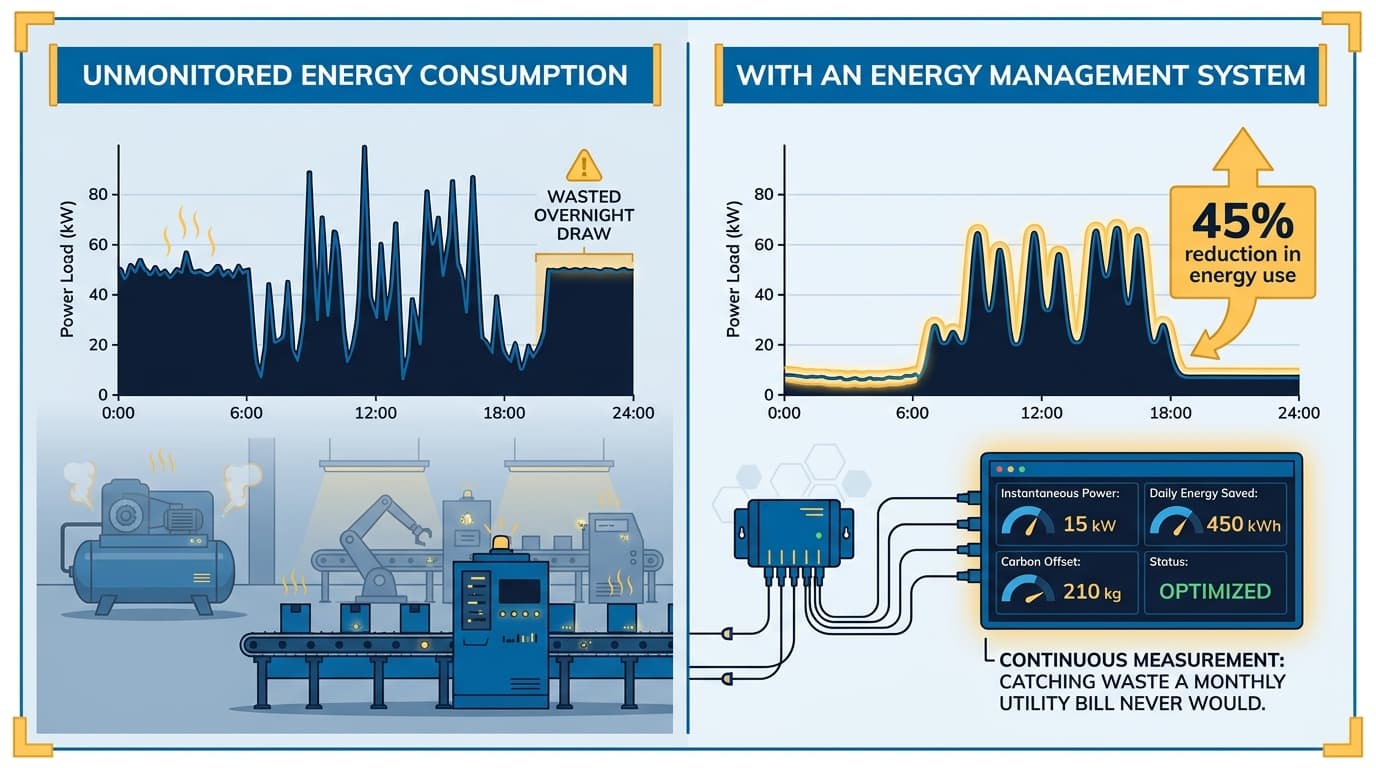
First, it collects data. Meters and sensors record how much energy is being drawn, where, and when, continuously rather than as a monthly snapshot from a utility bill. Second, it analyses that data, comparing current consumption against historical baselines to surface anomalies: a chiller running overnight with no production, a compressor cycling more often than it should.
Third, where the EMS is integrated with a building management or SCADA (Supervisory Control and Data Acquisition) system, it acts. It might adjust setpoints, stagger equipment start up to avoid demand spikes, or shut down idle loads automatically. Fourth, it reports. Dashboards and scheduled reports turn raw consumption data into something a facility manager or finance team can use to justify a capital request.
The first month of monitoring data often overturns assumptions. The compressor everyone blamed for high energy bills may turn out to be a minor contributor, whilst an idle production line quietly draws power around the clock. That gap between assumption and measured reality is usually where the first round of savings comes from.
For sites already running a granular power monitoring system, an EMS is often the next logical layer, turning monitoring data into automated action rather than a report nobody reads. Platforms such as EcoStruxure Power Monitoring Expert are built specifically for that handoff between visibility and control.
It is also worth separating an EMS from a building automation system (BAS). A BAS controls a wider range of building equipment, including lifts, access control, and fire systems, while an EMS focuses specifically on energy consumption. The two often share the same communication backbone but serve different purposes.
Core components of an EMS
An EMS is rarely a single product. It is usually an assembly of four layers.
Meters and sensors, measuring electricity, gas, water, or steam at the point of use
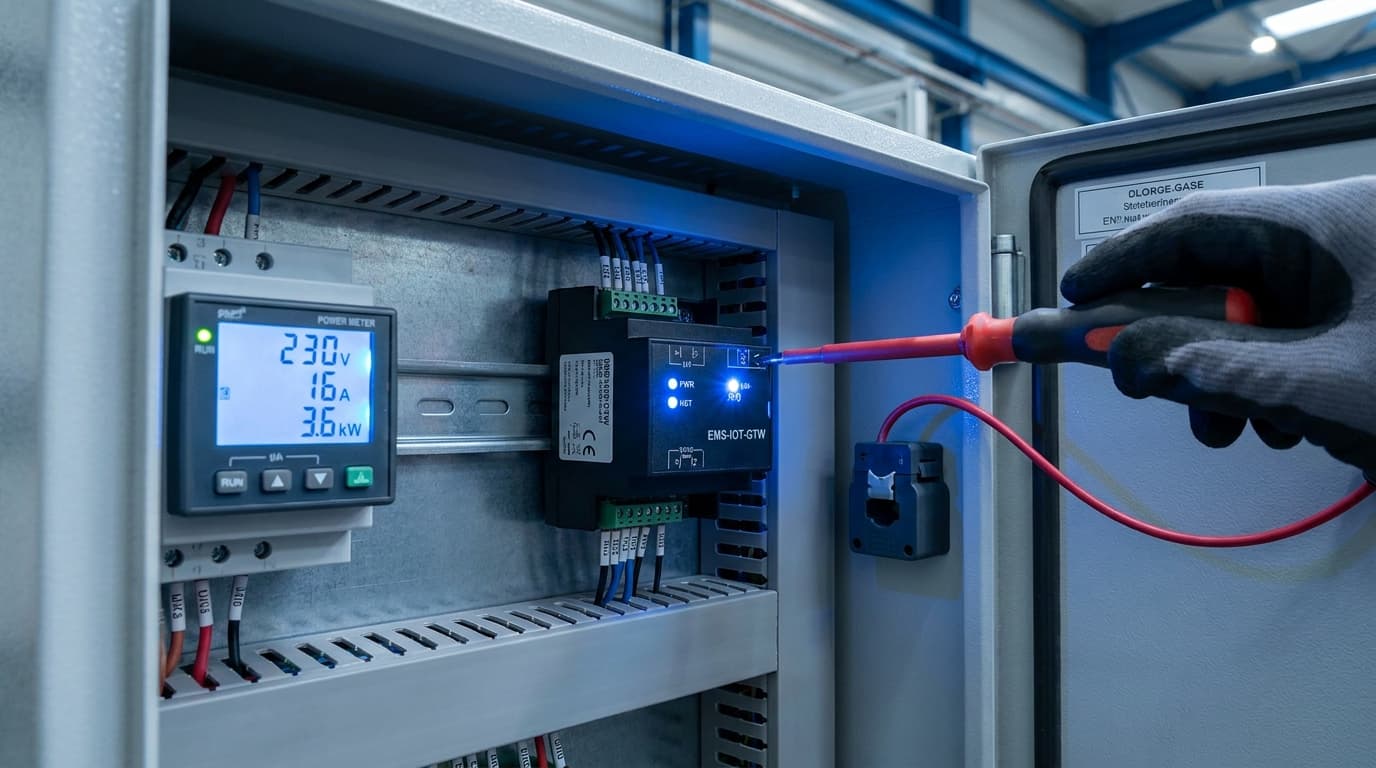
A communication and gateway layer, moving that data from the shop floor to software. An all in one IoT gateway such as the EcoStruxure Panel Server is a common example, bridging operational and IT networks
Analytics software, turning raw readings into patterns, alerts, and reports. Cloud based platforms like ABB Ability Energy and Asset Manager sit at this layer
Control interfaces, which let the system act on what it finds, from adjusting HVAC setpoints to shedding load during a demand peak
Not every facility needs all four layers on day one. Many organisations start with metering and monitoring alone, prove the savings case with real data, then add automated control once the numbers justify it.
Grid EMS vs building EMS vs industrial EMS
The table below should settle any confusion about which "EMS" a given search result, or government press release, is actually talking about.
| National grid EMS | Building EMS (BEMS) | Industrial EMS (IEMS) | |
|---|---|---|---|
| Scope | A country's power and gas transmission network | A single building's HVAC, lighting, and common services | A factory or plant's production processes and utilities |
| Typical operator | A grid or energy market authority | Facility or building manager | Industrial or energy manager |
| Example | Singapore's EMS II, run by the Energy Market Authority | Automated lighting and HVAC scheduling in an office tower | Monitoring and control across a manufacturing line |
Which type applies to your facility?
If you manage a building, plant, or campus, and you are reading this because an energy bill or a compliance letter landed on your desk, you want a building or industrial EMS. Not the grid level system a national authority operates.
Talk to an Engineer
Considering an energy management system for your facility?
Is an energy management system mandatory in Singapore?
For some organisations, yes. Under Singapore's Energy Conservation Act, companies classified as energy intensive, generally those consuming above a defined threshold of electricity, natural gas, or fuel each year, are required to appoint a qualified energy manager and implement an energy management system, typically aligned with ISO 50001. This process is often preceded by an Energy Efficiency Opportunities Assessment (EEOA), a formal review some organisations must complete before implementation.
For everyone else, adoption is voluntary but increasingly tied to incentives. According to Singapore's National Environment Agency (2024), eligible organisations can access co funding of up to 70% for implementing an EnMS or pursuing ISO 50001 certification, through schemes linked to Enterprise Singapore. Similar government sustainability grants exist in other markets too. The mechanisms differ by region, but the logic is consistent: regulators want facilities to measure before they are expected to manage.
Before committing to a full rollout, it is worth establishing where you actually stand. A structured Industry 4.0 readiness assessment like SIRI does exactly that. It also happens to produce the baseline documentation many grant applications require, so the audit and the funding case tend to move together.
Benefits of an energy management system
The most cited benefit is cost. Less discussed, but arguably just as important for compliance purposes, is visibility: an EMS gives a facility the data trail needed to demonstrate energy performance to regulators, certification bodies, or sustainability linked lenders.
There is a system level argument too. According to Singapore's Energy Market Authority (2024), system peak electricity demand is forecast to grow at a compound annual rate of up to roughly 5% over the next five years, driven by advanced manufacturing and the digital economy. Facilities that can shift or shed load during peak periods, a practice known as peak shaving, are better positioned as grid capacity tightens and, under demand based tariffs, cheaper to run.
The results are not uniform, but they are documented. Several Singapore companies that adopted EcoStruxure based energy management report concrete outcomes: Schneider Electric's own Kallang Pulse headquarters achieved a 45% reduction in energy use and BCA Green Mark Platinum Zero Energy status, while Samwoh Smart Hub reported efficiency gains of up to 50%. Outcomes like these depend heavily on the starting baseline. A facility with poor existing controls has more room to improve than one that is already optimised.
For a broader view of the technology behind these results, from energy efficiency solutions like smart building automation to LED retrofits, the pattern holds: measure first, then automate.
How much does an EMS cost, and is it worth it?
There is no single answer, because cost scales with scope. A basic sub-metering and monitoring setup for one building costs considerably less than an integrated system spanning multiple production lines with automated control. What determines payback period usually is not the EMS itself, but how quickly the data it produces gets acted on.
Facilities that treat the dashboard as a decision making tool, reviewing it weekly and assigning someone to chase down anomalies, tend to recover their investment faster than those that install the hardware and check in once a quarter. Practical strategies for cutting factory energy costs generally start with the cheapest fixes an EMS surfaces, such as scheduling and setpoint corrections, before any capital heavy retrofit is considered.
Grants can shift the maths considerably. Where co funding of up to 70% is available for qualifying projects, the effective payback period shortens substantially, though eligibility and documentation requirements vary. Confirm your position with a qualified assessor before budgeting around a grant that may not apply. If you are unsure which category your facility falls into, a free energy audit is usually the fastest way to find out: actual meter data settles the question faster than any spreadsheet estimate.
Getting started: choosing and implementing an EMS
Most successful rollouts follow a similar order of operations, whether the site is a single warehouse or a multi building industrial park.
Assess current energy use and identify where consumption and waste actually sit, not where they are assumed to sit
Set specific, measurable targets rather than a general aim to use less energy
Select the metering, software, and control layers that match the facility's actual scale, not the most feature complete option on the market
Implement in phases, validating savings at each stage before expanding scope
Monitor continuously and revisit targets as equipment, production volume, or tariffs change
This mirrors a five step approach used more broadly by Singapore's industrial SMEs for sustainability adoption: assess, set goals, implement, engage the people who will use the system daily, then monitor. Skipping the assessment step is the most common reason EMS projects underdeliver. Without a real baseline, it is difficult to prove the system paid for itself.
Talk to Precicon about your energy management system
An EMS is only as useful as the decisions it leads to. Whether you are weighing up compliance requirements under Singapore's Energy Conservation Act, trying to make sense of a data centre's power bill, or simply want to know where a factory's energy is actually going before spending on a fix, the starting point is the same: measure first.
Precicon's team works across energy management system solutions, from EcoStruxure based monitoring to cloud platforms like EcoStruxure Energy Hub, matched to the scale of the facility rather than sold as a one size package. Get in touch for a free energy audit or EMS consultation, and find out what your own meter data actually shows.
Frequently Asked Questions
SCADA is a broader industrial control technology used to monitor and control physical processes, not just energy, across utilities, water treatment, and manufacturing. An EMS is typically narrower in purpose, focused specifically on energy consumption, and may run on top of or alongside an existing SCADA system rather than replacing it.
Examples range from cloud based platforms like EcoStruxure Energy Hub, used for building level monitoring and tenant billing, to industrial grade systems like ABB Ability Energy and Asset Manager, which track equipment level consumption and asset health across a plant.
EMSs are generally categorised by scope: home energy management systems (HEMS) for residential use, building energy management systems (BEMS) for commercial properties, industrial energy management systems (IEMS) for factories and plants, and national grid level systems operated by energy authorities.
For energy intensive facilities, generally yes. The combination of reduced waste, compliance value, and available co funding usually outweighs the upfront cost. For smaller, low consumption sites, a lighter monitoring only setup may deliver most of the benefit at a fraction of the cost of a full system.
Yes, for organisations classified as energy intensive under the Energy Conservation Act, which requires a qualified energy manager and an EnMS aligned with ISO 50001. For other organisations, adoption remains voluntary but is incentivised through co funding schemes.
ISO 50001 is the international standard for energy management systems, setting out requirements for establishing, implementing, and improving an EnMS. Many EMS deployments are built to align with ISO 50001 so an organisation can pursue certification, which is often a condition for co funding or a compliance obligation.
In Singapore, eligible organisations can access co funding of up to 70% for EnMS or ISO 50001 implementation through schemes linked to Enterprise Singapore. A SIRI Assessment can help establish the documentation baseline these applications typically require.
Ready to see where your facility's energy goes?
Tell us about your facility and LKH Precicon's engineering team will get back to you.
Contact Us