

- OT (Operational Technology) is the broadest category: all hardware and software that monitors or controls physical processes.
- ICS (Industrial Control Systems) sits inside OT and covers the control layer, including PLCs, DCS and SCADA.
- SCADA is a specialised type of ICS built for centralised monitoring across widely distributed sites.
- The distinction matters because it decides who owns security at each layer, not just terminology.
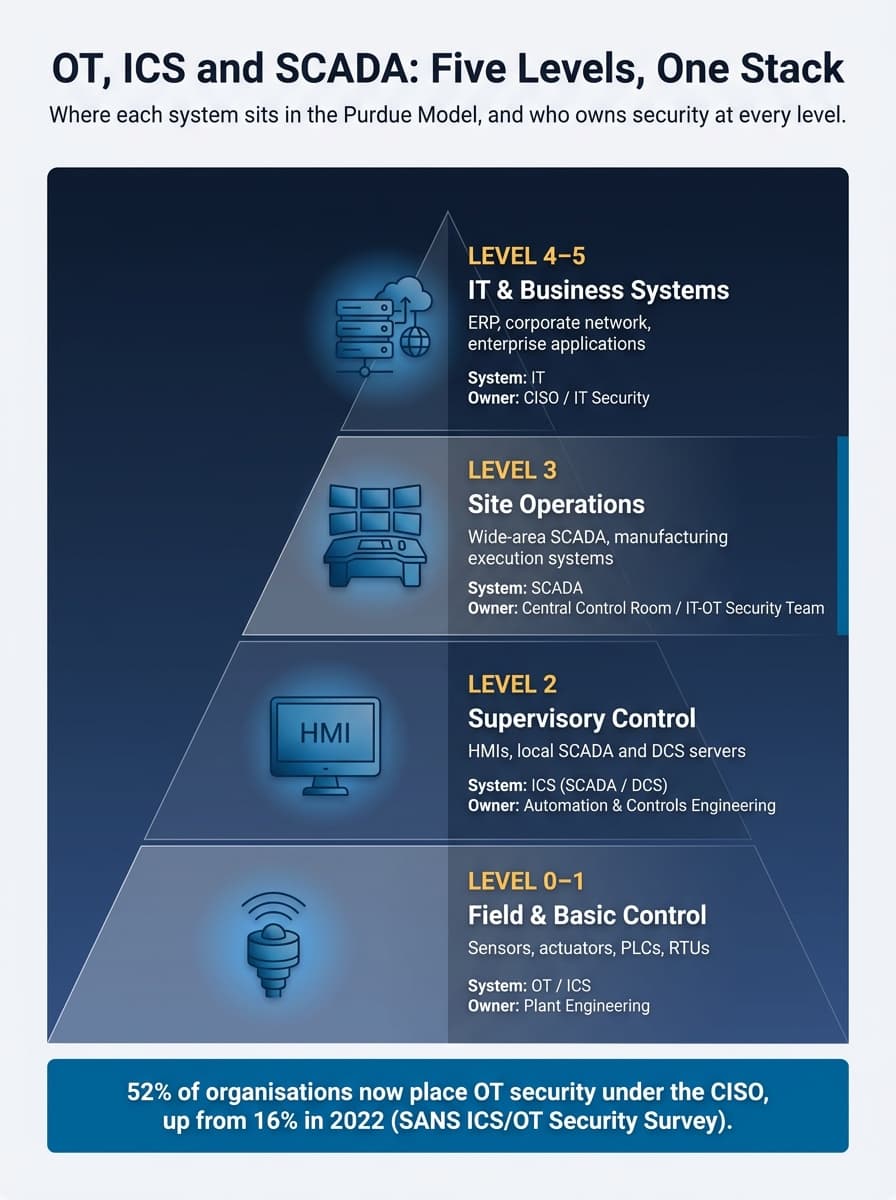
- According to the SANS ICS/OT Security Survey, 52% of organisations now place OT security under the CISO, up from 16% in 2022.
- A free initial consultation with LKH Precicon can help map where OT, ICS and SCADA meet in your own operation.
Operational Technology (OT) is the broad category of systems that monitor and control physical processes. Industrial Control Systems (ICS) are the subset of OT that automate those processes using PLCs, DCS and SCADA. SCADA itself is a specialised type of ICS built for centralised monitoring across widely distributed sites.
What do OT, ICS and SCADA actually mean?
Ask five engineers to define OT, ICS and SCADA and you'll likely get five different answers, often using the terms interchangeably in the same sentence. That's not a knowledge gap. The terms genuinely overlap, and getting the nesting right matters more than it sounds once security budgets and compliance obligations enter the conversation.
Operational Technology (OT) is the umbrella term for every piece of hardware and software that detects or causes a change in the physical world: a valve actuator, a conveyor sensor, a building management system, a turbine controller. If it touches a physical process rather than a spreadsheet, it sits inside OT.
Industrial Control Systems (ICS) is a subset of OT. ICS refers specifically to the control layer: the programmable logic controllers (PLCs), distributed control systems (DCS) and supervisory tools that automate and regulate industrial processes. Not every OT asset is part of an ICS, but every ICS is part of OT.
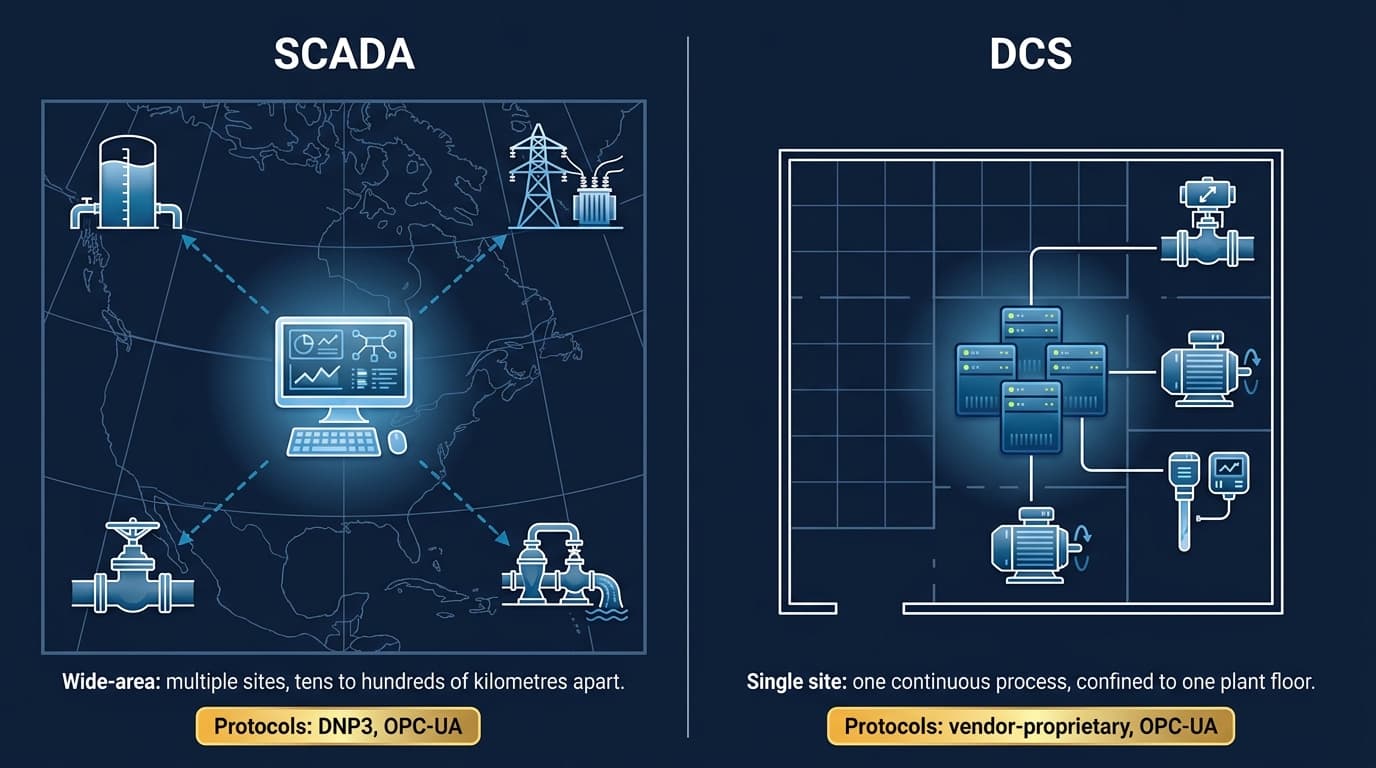
SCADA (Supervisory Control and Data Acquisition) is a subset of ICS. It's the architecture built for supervising processes spread across a wide geography, such as a national power grid, a water distribution network, or a fleet of remote pumping stations, from a single control room.
How OT, ICS, SCADA and DCS actually fit together
The cleanest way to picture the relationship is a set of nesting circles: OT is the outermost ring, ICS sits inside it, and SCADA occupies a slice of ICS alongside its close cousin, DCS. Where the two diverge is scope and geography, not function.
| System | Scope | Primary function | Typical protocols | Who usually owns security |
|---|---|---|---|---|
| OT | Entire physical operation | Monitor and control physical devices | Varies by asset | Plant engineering / operations |
| ICS | Industrial process layer | Automate and regulate processes | Modbus, PROFIBUS, EtherNet/IP | Automation/controls engineering |
| SCADA | Wide-area, distributed sites | Centralised monitoring and remote control | DNP3, Modbus, OPC-UA | Central control room / IT-OT security team |
| DCS | Single site, continuous process | Localised, high-density control | Vendor-proprietary, OPC-UA | Plant automation engineering |
This structure maps loosely onto the Purdue Enterprise Reference Architecture, the model most OT security teams still use to segment networks. Field devices sit at Levels 0 and 1, ICS controllers at Level 2, SCADA and DCS supervisory functions at Levels 2 and 3, and the IT/business network at Levels 4 and 5. Confusing which level you're securing is one of the more common, and expensive, mistakes in an OT security programme.
The protocols that quietly separate ICS from SCADA
Protocol choice tells you almost as much as function does. ICS controllers at plant level typically talk over Modbus, PROFIBUS or EtherNet/IP, protocols designed for tight, local determinism. SCADA systems, spanning far greater distances, lean more heavily on DNP3 and OPC-UA, both built to tolerate latency and intermittent connectivity over wide-area networks. When we've helped clients get systems talking to each other across the plant floor, this protocol mismatch is usually where integration projects stall. Not the hardware, but the handshake between layers that were never designed to speak the same language.
Why the distinction actually matters (not just semantics)
Here's the part most comparison articles skip: knowing the difference isn't a vocabulary exercise. It determines who in your organisation is actually accountable when something breaks, or gets breached.
Plant engineering traditionally owns ICS-level reliability: keeping a PLC logic loop running correctly is an operations problem, not a network security one. SCADA, by contrast, increasingly sits at the intersection of IT and OT, because it's networked, remotely accessible, and exactly the kind of asset a ransomware actor targets first. Treat all three as one undifferentiated blob called "OT security" and you'll inevitably under-resource the layer that's actually most exposed.
That accountability gap is shifting fast, and not because anyone chose it out of preference. According to the SANS ICS/OT Security Survey, cited in Precicon's review of the state of ICS/OT security, 52% of organisations now place OT security under the CISO, up from just 16% in 2022, a clear signal that boards no longer accept "that's the plant manager's problem" as an answer. Getting real-time visibility into that layer isn't only a security question either. It's directly connected to measurable gains in Overall Equipment Effectiveness, since the same monitoring data that flags a security anomaly also flags the early signs of mechanical drift.
Talk to an Engineer
Not sure which of your systems count as OT, ICS or SCADA?
The real-world stakes: when OT/ICS/SCADA security fails
The consequences of getting this wrong aren't abstract. Stuxnet, discovered in 2010, targeted ICS-level PLCs directly, reprogramming centrifuge controllers while feeding operators false SCADA readings. It remains a textbook illustration of why the two layers need separate defences, not a single shared password policy. Industroyer, used against Ukraine's power grid in 2016, manipulated SCADA protocols specifically to cut electricity to hundreds of thousands of homes.
Closer to the sustainability conversation many manufacturers are having right now, we've watched a single ransomware incident undo two years of a factory's sustainability progress. Not because attackers cared about carbon metrics, but because taking energy management systems offline forced the plant back onto inefficient manual operation for weeks. OT security isn't a side conversation from your ESG targets. Increasingly, it's a precondition for hitting them.
How to know where your organisation actually stands
Most teams don't need a fresh audit methodology. They need to walk through their own environment against a short list of questions.
List every OT asset and tag it: is it OT-only, ICS, SCADA or DCS? Most organisations discover shadow assets nobody formally owns during this step alone.
For each layer, name the team accountable for security, not just uptime.
Identify where Modbus/PROFIBUS traffic crosses into DNP3/OPC-UA territory. That boundary is where segmentation usually fails first.
Ask whether your team could detect an anomaly at each layer within minutes, or whether it would surface as a production issue days later. Consistent 24/7 remote condition monitoring closes exactly this kind of blind spot for clients running distributed equipment.
If that exercise raises more questions than it answers, that's normal. It's precisely what a proper Industry 4.0 readiness assessment is designed to formalise, mapping your OT, ICS and SCADA layers against a structured benchmark rather than a gut feeling.
Get clarity on your own OT/ICS/SCADA environment
Understanding where OT ends and ICS or SCADA begins is the easy part. Applying that understanding to your own plant floor, where legacy PLCs, a decade-old SCADA interface and a newer DCS might all be running side by side, is where most teams get stuck.
If you'd like a second pair of expert eyes on how your systems are actually structured and what that means for security and reliability, get in touch with our team for a free initial consultation. We'll help you work out exactly where OT, ICS and SCADA meet in your operation, and what to prioritise first.
Frequently Asked Questions
OT stands for Operational Technology: the hardware and software that detects or causes a change in the physical world, from a valve actuator to a turbine controller. In a SCADA context, OT is the physical layer that SCADA ultimately monitors and controls.
ICS stands for Industrial Control Systems, and SCADA is one specific type of ICS. Where ICS is the broader control layer covering PLCs, DCS and supervisory tools, SCADA is the ICS architecture built specifically for centralised monitoring of processes spread across a wide geography.
OT is the broader category covering all hardware and software that monitors or controls physical processes. ICS is a subset of OT focused specifically on the control layer, including PLCs, DCS and SCADA, used to automate industrial operations.
OT is the entire category of systems that monitor and control physical processes, while SCADA is one specific, specialised type of system within that category. Every SCADA system is OT, but most OT assets, such as a single sensor or actuator, are not SCADA systems themselves.
SCADA has evolved through four generations: monolithic (early, standalone systems with no networking), distributed (multiple stations networked across a local site), networked (open, standards-based architectures like Modbus and DNP3 enabling multi-vendor interoperability), and IoT-based (modern, cloud-connected SCADA using IIoT sensors and remote access).
SCADA manages geographically dispersed assets from a central control room, prioritising wide-area communication. DCS controls a single, continuous process on one site, using distributed local controllers positioned near the equipment itself.
Responsibility has traditionally sat with plant engineering or operations teams, but that's changing quickly. Recent industry data shows OT security now reports to the CISO in the majority of organisations, up sharply from just a few years ago.
Organisations operating Critical Information Infrastructure in Singapore fall under the Cybersecurity Act, overseen by the Cyber Security Agency of Singapore (CSA). IEC 62443, the international standard for industrial automation and control systems security, is the most widely referenced technical framework alongside it. Verify current compliance requirements with CSA or a qualified OT security advisor before finalising any control programme.
Need clarity on your OT, ICS and SCADA environment?
Tell us about your facility and LKH Precicon's engineering team will get back to you.
Contact Us