

Operational technology (OT) is the hardware and software that monitors and controls physical equipment, from a single sensor to an entire production line. It includes programmable logic controllers (PLCs), SCADA systems and distributed control systems (DCS). Unlike IT, which manages data, OT keeps machinery running safely. Get the fundamentals right before investing in OT security or energy upgrades.
- OT is the hardware and software that directly monitors and controls physical processes, not data or applications.
- The three core OT systems are PLCs (single machines), SCADA (site-wide monitoring) and DCS (continuous processes).
- OT prioritises safety and uptime first; IT prioritises data confidentiality first. That difference shapes everything else, including how each is secured.
- IT/OT convergence brings real efficiency gains but also drags older OT systems into modern cyber threats.
- In Singapore, OT tied to Critical Information Infrastructure (CII) falls under the Cybersecurity Act and the Cyber Security Agency (CSA).
- Choosing the right OT engineering partner matters as much as choosing the right equipment.
What is operational technology? (core definition)
Operational technology is the collective term for the hardware and software systems that directly monitor and control physical devices, processes and infrastructure. Where information technology manages data (spreadsheets, emails, cloud applications), OT interacts with the physical world: opening a valve, starting a motor, adjusting a conveyor's speed.
The term dates back to a 2006 Gartner briefing, coined to separate factory-floor control systems from corporate IT networks. That separation mattered because the two had almost nothing in common. IT teams patched software on a monthly cycle; OT engineers kept a control system running for fifteen years without touching it, because uptime and safety outranked everything else.
That distinction still holds. A power station's turbine controller, a semiconductor fab's environmental monitoring system, and the PLC running a bottling line on a factory floor in Tuas all fall under OT. Each one exists to keep a physical process safe, stable and running, not to store or move information.
The building blocks of OT: PLC, SCADA, DCS and HMI
Most OT conversations end up citing the same handful of acronyms without ever explaining what separates them. Here's what each one actually does.
What is a PLC (programmable logic controller)?
A PLC is a ruggedised industrial computer that runs a fixed set of control logic (if this sensor trips, stop that motor) for a single machine or process. It's the workhorse of the factory floor: cheap, reliable, and built to survive dust, vibration and temperature swings that would kill a standard server.
What is a SCADA system?
SCADA (Supervisory Control and Data Acquisition) is a software layer that sits above multiple PLCs, pulling data from them and giving operators a single screen to monitor and adjust an entire site: a water treatment plant, a power grid, a chain of production lines spread across a building.
What is a DCS (distributed control system)?
A DCS performs a similar job to SCADA but is built into a single, continuous process rather than bolted onto separate machines: think oil refining or chemical processing, where thousands of control loops need to work in constant coordination rather than as discrete steps.
| System | Best suited to | Typical scale |
|---|---|---|
| PLC | A single machine or process step | One production line or cell |
| SCADA | Monitoring and control across a distributed site | Multiple systems, one facility or several sites |
| DCS | Continuous, tightly coupled processes | Whole plants (refineries, chemical processing) |
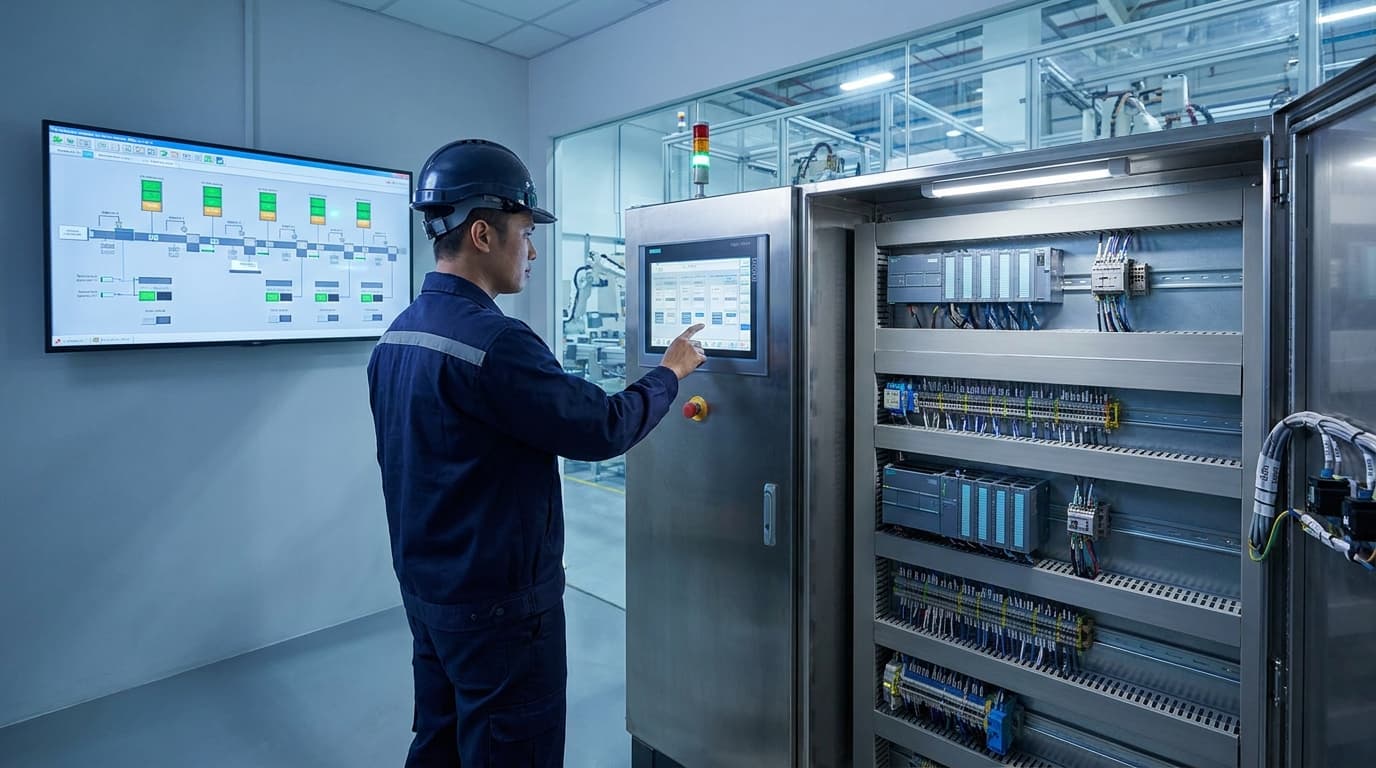
HMI (human-machine interface) is the screen, often a touch panel mounted directly on machinery, through which an operator reads a PLC or SCADA system's data and issues commands. It's the part of OT most people picture first, even though it's the smallest piece of the system.
Because PLCs and DCS platforms are built to last fifteen to twenty years, many facilities now approach ageing control systems as part of a wider digital retrofit programme rather than a one-off swap, modernising the control layer without ripping out equipment that still works mechanically.
How does OT differ from IT?
The short version: IT manages information, OT manages physical processes. The longer version is where the practical differences show up, and where a lot of miscommunication between departments starts.
| IT | OT | |
|---|---|---|
| Primary focus | Data, applications, networks | Physical equipment and processes |
| Top priority | Confidentiality first | Safety and availability first |
| Typical lifecycle | 3 to 5 years before replacement | 15 to 20+ years in service |
| Patching cadence | Regular, often automated | Rare, scheduled around planned shutdowns |
| Failure consequence | Data loss, downtime, cost | Equipment damage, safety risk, physical harm |
That priority order (safety and availability before confidentiality) is the single biggest reason OT can't simply borrow IT's cybersecurity playbook. Patching an IT server overnight is routine. Patching a control system on a live production line means scheduling downtime, testing for side effects, and accepting that a single misconfigured update could stop the line entirely.
Why IT/OT convergence raises the security stakes
For most of OT's history, this separation was also a security boundary. A control system with no connection to the outside world is hard to attack remotely, whatever its other flaws. That boundary has been dissolving for a decade, as businesses connect OT networks to IT infrastructure for real-time reporting, remote monitoring and predictive maintenance. This drags OT's much older, less-patched systems into the same threat landscape as everything else on the network.
Singapore has already legislated around this. Under the Cybersecurity Act, operators of Critical Information Infrastructure (CII), covering power, water, healthcare, transport and several other sectors, carry specific obligations to the Cyber Security Agency of Singapore (CSA), including incident reporting and regular risk assessments. If your OT environment touches any of those sectors, this isn't optional reading.
The risk isn't hypothetical. One manufacturer's ransomware attack that unravelled two years of sustainability progress shows what happens when IT and OT networks aren't properly segmented: a single compromised endpoint took down systems that had nothing to do with the original entry point. Our own review of the state of ICS and OT security covers this in more depth, including where most facilities' defences are thinnest.
None of this means avoiding connectivity. The efficiency gains from industrial IoT monitoring are real. It means designing the connection properly: segmented networks, monitored traffic, and a clear line of sight into what's talking to what.
Talk to an Engineer
Reviewing the OT systems in your facility?
Real-world OT in action: examples across Singapore industries
Most articles on operational technology reach for the same two examples: the 2021 Colonial Pipeline shutdown in the US, and the 2015 attack on Ukraine's power grid. Both are real and well documented, but neither reflects what OT looks like for the vast majority of businesses running it day to day.
Closer to home, OT is the temperature and humidity sensors keeping a cleanroom within tolerance, the machine data feed telling a production manager which line just dropped below target OEE, and the 24/7 remote condition monitoring that flags a bearing running hot before it fails at 2am on a Sunday. None of these make the news. They're also where OT delivers the most consistent value: not preventing a headline-grabbing catastrophe, but catching the everyday failures that quietly erode uptime.
This is the scale most of Singapore's manufacturing sector actually operates at: mid-sized facilities in electronics, precision engineering and food production, where a single unplanned stoppage can cost more than a year of preventive maintenance would have.
Is OT security regulated in Singapore?
Yes, for a defined set of sectors. Singapore's Cybersecurity Act gives the CSA authority to designate systems as Critical Information Infrastructure when their disruption would significantly impact essential services: energy, water, healthcare, banking, transport, government, media, security and emergency services, among others.
If your OT environment is designated CII, obligations include conducting regular cybersecurity audits and risk assessments, reporting incidents to CSA within prescribed timeframes, and complying with codes of practice specific to your sector.
If you're outside those designated sectors, the Act doesn't apply directly, but the underlying practices it requires (segmentation, monitoring, incident response planning) are worth adopting anyway. Regulation tends to formalise what good OT security already looks like; it rarely invents new requirements from nothing.
How to choose the right OT engineering partner
Once the fundamentals are clear, the harder question is who actually implements and maintains them. A few things worth checking before signing anyone:
- Do they offer genuine automation systems integration, or do they only supply components and leave the integration work to you?
- Can they work across your existing equipment, or does every recommendation happen to be their own product line?
- Do they understand your specific process, such as semiconductor, food and beverage, or heavy manufacturing, or is their experience generic?
- What happens after commissioning? A partner who disappears after installation isn't a partner, just a vendor.
- Can they show you a working example, not just a brochure?
If you're not sure where your facility currently stands, a SIRI Assessment is a reasonable starting point: it benchmarks your operations against Singapore's Smart Industry Readiness Index and gives you an objective baseline before you commit to a direction.
Get your OT fundamentals right
Operational technology isn't going away, and neither is the pressure to connect it more tightly to the rest of the business. The fundamentals matter more than ever: what your PLCs, SCADA and DCS actually do, where OT and IT genuinely differ, and what your regulatory obligations are. Get those right, and everything after, security included, actually works.
If you're weighing up where your facility stands or want a second opinion on an existing setup, get in touch with Precicon's engineering team to talk through your specific environment.
Frequently Asked Questions
Operational technology refers to the hardware and software systems that directly monitor and control physical devices, processes and events within an organisation, such as sensors, control systems and actuators, rather than systems that manage data or business applications.
IT focuses on processing and moving information: data, applications, networks. OT focuses on controlling physical machinery and processes. IT typically prioritises data confidentiality first; OT prioritises safety and operational reliability first, which changes how each is secured, maintained and upgraded.
An OT system is the combination of sensors, control systems (PLCs, SCADA, DCS) and actuators that work together to keep an industrial process running safely and efficiently, whether that's a single machine or an entire facility.
OT is the broadest term, covering all hardware and software that controls physical processes. ICS (industrial control systems) is the subset of OT specifically responsible for managing industrial processes. SCADA is one type of ICS, focused on centralised monitoring and control across distributed sites.
OT security is the set of practices and technologies used to protect operational technology from cyber threats, including network segmentation, continuous monitoring, access control and incident response planning, with the goal of keeping physical processes safe and running rather than just protecting data.
The most frequently cited risks are legacy systems that can't be easily patched, limited cybersecurity awareness among OT personnel, and the convergence of OT and IT networks, which exposes older OT equipment to threats it was never designed to withstand.
Yes, for systems designated as Critical Information Infrastructure by the Cyber Security Agency of Singapore. Designated operators must conduct regular risk assessments and report incidents within set timeframes; other operators aren't legally required to comply but benefit from adopting the same practices.
Look for genuine systems integration experience rather than just component supply, familiarity with your specific industry, ongoing post-commissioning support, and a track record you can verify against real projects rather than marketing claims.
Talk to our team about your OT environment
Tell us about your facility and LKH Precicon's engineering team will get back to you.
Contact Us